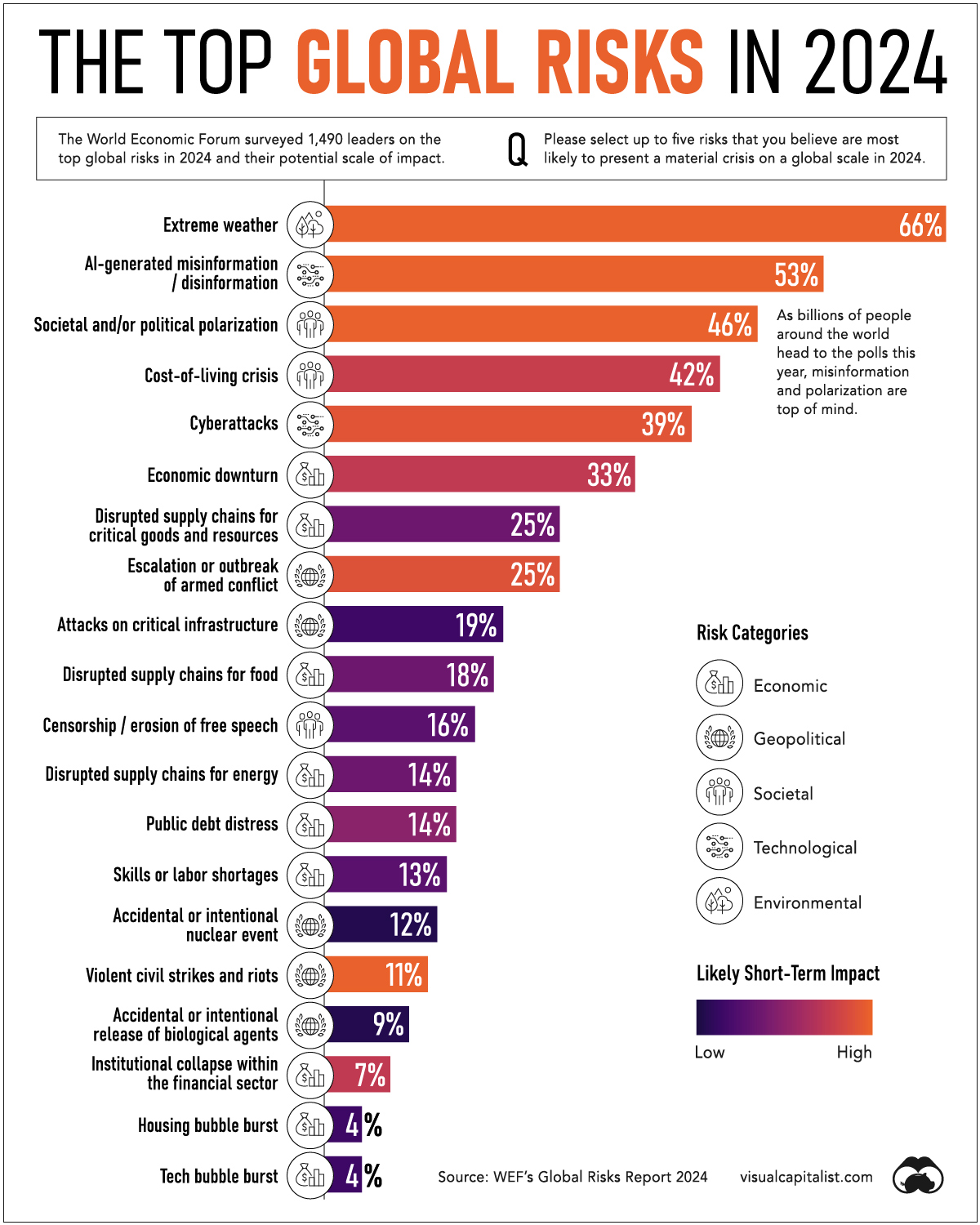
The World Economic Forum’s assessment of Global Risk is based on a survey of 1,490 leaders. The risks are grouped into five categories, but to me they all look to be created by humans – including the top risk, extreme weather. Note that these risks focus on material crises so tend to have an economic focus. Major issues such as biodiversity decline and income inequality are not considered.
It makes sense to conceptualise the crises as a meta-crisis, as all facets of the crisis can be connected as they are created by humans. I would like to think that we are Homo empathicus as posited by Jeremy Rifkin (see below), but he warns that our innate empathic nature is subverted by our families, and institutions, enabling the instincts of greed and competition to flourish.
Greed and self-interest have always been with us, but even the wealthiest and most powerful rulers in traditional societies were limited by the amount of damage they could do. Industrialisation and the consumerism it has spawned have magnified greed enabling the accumulation of wealth beyond to wildest dreams of former despots.
Note that numbers two and three on the list includes the note “as billions of people around the globe head to the polls this year, misinformation and polarisation are top of mind”. Together, one or both of these two risks were identified by 99% of those surveyed.
Polarisation
Considering the climate crisis, we have most of the technology we need to mitigate it, either in our hands or in the pipeline. What we don’t have is the ability required to work together for solutions. We have this ability in small groups and communities but aren’t able to consummate it in larger communities. Sooner or later we encounter another community with conflicting perspectives and we get tribal.
Amanda Ripley, the author of High Conflict, says that conflict is necessary, but when it becomes toxic (high) it becomes very counter-productive. She identifies four factors that contribute to high conflict.
- Group identities – when our identity becomes strongly embedded in a group, others with opposing perspectives become the “them” to our “us”. Identifying a group that poses a threat – even if that threat has no substance is a crude tactic used by some politicians.
- Conflict entrepreneurs – these are the people that create conflict effortlessly. You can probably identify some you know personally and are aware of in the public sphere.
- Humiliation – Humiliating a person or a group spawns conflict. The humiliation Germany suffered through the Treaty of Versailles created conditions for the rise of the Third Reich.
- Corruption – According to Daniel Serwer “corruption fuels conflict by undermining the rule of law, worsening poverty, facilitating the illicit use of resources and providing financing for armed conflict”.
Indeed it is tragic that many peoples’ collective efforts to heal facets of the meta-crisis are negated by the onset of wars and other manifestations of personal and corporate greed.
Depolarising
Governments in democracies at least, tend to follow the mood of their electorate validating the truism that people get the government they deserve. Depolarisation can certainly be influenced by a well-intentioned government, but has to be built on community foundations. Self-reflection and working constructively in our communities is a good place to start. High Conflict includes some great ideas about resolving conflict.
Personally, I am reflecting how I became too emmeshed in political discourse over the last few months. So I have resolved to avoid those thoughts and discussions and to lean into spiritual practices that help me to rise above tribal politics. And in my whanau, my community and the people I work with it means backing away from things that might trigger potential toxic conflict. Even thinking, but not articulating thoughts that could lead to toxic conflict are to be avoided as I am aware that my internal dialogue and behaviour need to be congruent.
This provides a foundation for me to be more effective in communities and climate action. In my role with Climate Action Tai Tokerau, I intend to set up spaces for people to engage on these issues to identify practical remedies for polarisation.
What does this mean for you?
 Bruce-Iri
Leave a comment