Change and engagement, part one

The way we are changing is changing. The predominant approach to change has been to mandate it. An elite, at the top of the organisation, perceive a need for change and direct others to implement it. They will anticipate some resistance and have some strategies ready to overcome it. Often this change will involve some type of restructuring.

There is mounting evidence that this type of change doesn’t work very well and may actually deplete rather than add value. For some organisations, the frequency of this type of change results in a series of self-inflicted, debilitating injuries.

A recent Bain & Company study of 57 major reorganizations found that fewer than one third produced any meaningful improvement in performance. Some actually destroyed value.

Mandated change, bold strokes and long marches

Twenty years ago, in her book The Challenge of Organizational Change, Rosabeth Moss Kanter and her co-authors identified two types of change, bold strokes and long marches. Bold strokes are big strategic moves, such as buying another company, generating a large capital investment, or developing a new product. Bold strokes are usually mandated by the actions of “one or a few people”.

(Tom Peters’ take on mergers)

Long marches are more operational initiatives such as merging departments, transforming quality or customer relationships. According to Rosabeth Moss Kanter, “they require the support of many people and cannot be mandated in practice”

Of course we will continue to need a degree of mandated change, and other stakeholders such as government will mandate external change. We just need to hope that the skill and ability to design and manage change will improve.

Too frequent use of restructuring will come to be seen as the  corporate equivalent of the old medical practice of blood-letting and a sure symptom of dysfunction.

According to Rosabeth Moss Kanter, long march change will have more dependable long term results and is more likely to change culture and habits. She then elaborates on the enduring foundation of sustainable organisational change – decision making.

Every large and complex organisation has many thousands of people who have each day the opportunity, or are literally required, to take action on something. We think of these as “choice points.” For an organisation to succeed in any long-run sense, these millions of choices must be more or less appropriate and constructive day in and day out. But this is an immensely difficult problem, because it requires the ultimate in decentralisation – literally to the individual level – along with centralisation in the sense that those individual choices must be coordinated and coherent.[1]

This same theme is echoed two decades later by Marcia Blenko in the Harvard Business Review:

In reality, a company’s structure results in better performance only if it improves the organisation’s ability to make and execute decisions better and faster than its competitors.[2]

Her she is elaborating on the centrality of decision effectiveness in sustaining effective change.

The engagement connection

Marcia Blenko’s establishes a link between decision effectiveness and employee engagement. Rosabeth Moss Kanter emphasised the importance of “choice points” throughout the organisation. And while the focus is on big business, even small businesses manifest thousands of choice points if we consider all employees and stakeholders.

Embedding a stakeholder ethos (including employee engagement) throughout the organisation will build resilience and adaptive capacity. Over time, it is more likely that those highly engaged staff will be making decisions and choices aligned with the best interests of the company. And over time there will be less need for mandated change.


[1] Rosabeth Moss Kanter, Barry Stein and Tod Jick. The Challenge of Organizational Change: How Companies Experience It and Leaders Guide It. New York: Free Press, 1992, page 492, 495

[2] The Decision-Driven Organisation, by Marcia Blenko, Michael Mankins and Paul Rogers In Harvard Business Review June 2010, page 57

Engagement and community building – the White Dog Café

In 1983 Judy Wicks started the White Dog Café in Philadelphia. It has become an exemplar for a community-based enterprise.

Where I live, community enterprise is slowly but surely being eroded as an increasing number of national or international chain stores supplant local stores. While this typically provides benefits such as cheaper goods the longer-term impacts are not beneficial for the local community (more about this in a later blog).

The White Dog Café started off as a restaurant, and remains a restaurant, but it has become the centre of a local network of suppliers, customers, employees and community interests. In the early years of the restaurant, Judy became increasingly troubled that the meat on her menu came from industrial farms. She changed to free range pork and then other meat and chicken and free range eggs. If produce is available locally, and is preferably organic, the White Dog Café purchases it in preference to imported food.

Initially Judy regarded locally sourced production as a point of difference for her restaurant, but her thinking evolved to consider the greater good and she went about engaging other restaurateurs in the concept. Her engagement with local farmers and growers created momentum for the establishment of the Fair Food initiative. Farmers and growers benefit from having a larger market for their produce locally. This animal welfare aspect of the White Dog Café remains one of her strongest motivators.

Networks of services

A restaurant depends on a web of services to operate. As Judy sorted out the produce for her menu, she became aware of a series of expanding possibilities to make the restaurant more sustainable and support the local community. She sourced renewable electricity and created a solar-heated water supply. Organic waste is composted and other waste recycled where possible. Local products are used whenever possible – for example locally produced soap is purchased for hand washing. For those products not available locally, such as tea, sugar and coffee, Fair Trade sources are used.

The invisible had works when we live in the same community.[1]

Staff also benefit from the sustainability philosophy – Judy pays a “living wage”. The Restaurant also supports a number of local community service projects such as Crime Victim Services and many others.

Business philosophy and selling the business

The mission statement of the White Dog Café is “Serving our customers, serving each other, serving our community and serving the earth”. Business decisions are based on serving the greater good, growing consciousness and increasing happiness.

After 30 years in the restaurant business Judy decided to sell the restaurant to help her focus on the promotion of sustainability. She wanted to keep the mission of the White Dog Café alive, so she found a local purchaser and retained the rights to the name of the business. To perpetuate the sustainability agenda she set up a Social Contract that keeps the White Dog Café on the same trajectory. The purchaser is able to set up other branches as long as they have 51% local ownership. This video outlines Judy’s perspectives, the restaurant’s operations and the Social Contract.

Above all, Judy has show how one business can generate social good by building rich networks in its local community. Do you know of other examples?

image credit: Real People Eat Local

Social capital and good books

“Social capital… reflects the community skills that have co-evolved with individual skills. People working together generate webs of social capital”. So say Jessica Lipnack and Jeff Stamps in Virtual Teams. Social capital is built on rich social networks.

It is a delicate thing. Social networks are forged from trust and as anyone who has suffered from infidelity in a relationship can tell you, trust builds up over time and but is very easy to destroy. According to Stephen Covey, trust becomes established when individuals demonstrate character and competence. Where these intersect trust and credibility is established.

Stephen Covey’s model of trust

We can easily see the beneficial consequences of trust and the accumulation of social capital when we consider those societies where trust and social capital has been shattered. Many of us can only imagine what it would be like to live in community where there is frequent violence, abuses and threats. In circumstances such as these the dismantling of social capital is accelerated when the state is perpetuating abuses.

Social capital is relevant for all social units: families, cities, businesses and nations. According to Lipnack and Stamps:

People generate wealth in dense networks of horizontal relationships in two primary ways because they lower transaction costs [and] increase opportunities for cooperation.[1]

A simple example is the knowing a friend will meet you as agreed, although a week has elapsed since the meeting was scheduled. You can probably think of a friend like this – and, by contrast, those that you would always contact to confirm the meeting. The extra workload, even if it is only small as illustrated in this example, reveals an added “transaction cost” to the relationship. Stephen Covey Junior provides another example in The Speed of Trust. A New York street vendor selling hot dogs found long queues dissuaded potential customers. He decided to enable customers to make their own change. This freed him up from dealing with cash and enabled him to provide much quicker service. His customers appreciated being trusted.

Now take these small gains and multiply the effect in large organisations (such as businesses) and their multiple stakeholders. The difference between a high trust and low-trust environments is clearly substantial.

Better World Books

Better World Books exemplify the development of social capital. They are a social business, motivated to do good. The profits flow, and they disburse much of them by supporting literacy initiatives around the world. According to Kevin Jones Better World Books “is now approaching $60 million in revenues with healthy profits and a compound annual growth rate of 35 percent. It’s donated more than $11 million to nonprofit groups helping to give the gift of literacy.[2]

Better World Books stock comes from donations from individuals, educational institutions and libraries. They are sold for a reasonable price to fund the company’s philanthropy. The Good Capital Social Enterprise Expansion Fund (SEEF) invested in Better World Books to aid it through its establishment phase. So we have a company who have a philanthropic supply chain, have staff who are no doubt inspired by the company’s mission, social enterprise investors, customers who buy into the mission and an increasing cohort of beneficiaries of literacy programmes. This is a potent recipe to build social capital that extends well beyond the boundaries of the company.

As Professor Muhammad Yunus says, every problem can be solved with a social business. The challenge for more conventional companies is how to use this dynamic and learn from its masterclass of engagement and social capital accumulation.

Here is a YouTube video of Better World Books. Note that the figures presented are four years out of date (reinforcing their incredible growth).

[1] Jeffrey Lipnack and Jessica Stamps: Virtual Teams: People Working Across Boundaries With Technology (2008) http://www.netage.com/pub/books/VirtualTeams2.html

Book review – We: How to Increase Performance and Profits Through Full Engagement

Rudy Karsan and Kevin Kruse’s book is pragmatic and of use to anyone looking to improve employee engagement. The book is organised into four parts. The first two deal with the individual and I will get my objections to them out of the way before discussing the gems to be found in parts three and four.

In parts one and two the focus on the individual is understandable – as engagement happens from heart to heart. We know that globally, the rates of disengagement are too high and too many people are disconnected from their work. I also accept that people will feel more fulfilled if they find meaning and purpose in their work – but after reading the first few chapters I was left with an impression that we are Homo economicus – we are one dimensional and our primary function is our work. Through our work we will find fulfilment and happiness. But it feels like a rationale to get people to work harder.

As a New Zealander one bad habit my fellow Kiwis share with the people of the United States (the home of the authors) is that we work long hours – we work too hard. Work-life balance is seriously out of balance. In this context I get concerned when I encounter an evangelistic approach towards the virtue and necessity of hard work.

The positives

Having got that out of the way, this book has many gems. The authors have obviously rolled their sleeves up and got involved with engagement processes. They share the three questions they use to gauge engagement (you will find them in the book). I am a fan of short and open survey questions and intend to incorporate these into my work.

The authors make a beautiful distinction: harmonisation = engagement + alignment.

Engagement is the catalyst to get you to that extra edge in performance, while alignment ensures everyone is heading in the same direction. (page 145)

They raise the bar for us here. Some organisations struggle to get to the point of surveying staff about engagement. They may or may not do anything with the information gleaned. To ensure the material issues blocking greater engagement are addressed, and then to go on to align people across the various structural and ideological barriers in an organisation is a worthy aspiration.

Another concept that resonates with me is their management prescription, embodied in chapter eight – “great managers focus on growth, recognition and trust”. This chapter atones for the issues outlined earlier. The authors prefer valuing employees to recognising employees. To survey your employees, survey them to see to what extent they agree with the statement “I feel valued as an employee of this company.” They prefer it to “I receive recognition when I do good work”.

Valuing is about appreciating the worth of something (someone) and of esteeming something (someone) highly. When we value employees, we appreciate them for who they are and what they bring to the organization. We acknowledge them not merely for tasks, but to the deeper intrinsic worth they add to the organization by just being there. (page 177)

When authors apply concepts about qualities of character, such as trust and trustworthiness, they reveal to me a deeper understanding of the human condition than encountered in many business books. Rudy Karsan and Kevin Kruse highlight trust as an important driver of employee engagement. To understand this better they suggest questions such as: “How can our leadership team foster greater trust among employees?” The three qualities that inspire trust are competence, caring and commitment.

It is hard to find books that focus on engagement – so this one is well worth the purchase price. If you know of others you would recommend, please comment.

We: How to Increase Performance and Profits Through Full Engagement by Rudy Karsan and Kevin Kruse (2011) New Jersey: John Wiley

website: www.wethebook.com

Leadership and engagement – keeping it simple

Some people say that you can’t teach leadership in a classroom. In some ways I agree, because learning leadership should be like learning to walk – something a baby finds difficult and scary, but evidently possible as there are so many role models doing it.

I have been teaching leadership for five years and one of the benefits of teaching, is that your “radar” is on continuously looking for real-life examples of theory. In my class I use two models from Dr Peter Cammock’s The Dance of Leadership. I love these models for their simplicity. My students have road-tested them and found them to be powerful and easy to use.

The heart of leadership

This model harmonises the two core fundamentals of leadership, knowledge of self and concern for others. Great leaders, from parents to more public examples of leadership are exemplify this. I think of Sir Peter Blake, who was so confident in his own ability, and so caring of his crew. Or my mum, who I never heard speak ill of anyone.

Surrounding the heart of leadership are four “qualities of character”. Peter Cammock has chosen integrity, faith, courage and passion. We could just as easily choose other qualities of character as I suspect that they all link to one another.

The envision, engage, enact model (3 Es)

While the “heart of leadership” models who we should be, the 3 Es model shows us how to lead.

At its simplest it is a three-step model: envision – engage – enact. This is easy to remember and relate to. Peter Cammock weaves these three core leadership roles into a prescription for leadership and change that is applicable to most human endeavour.

The three-step model elaborates to 10 steps. Good leaders follow this process naturally. They know when to talk, they know when to roll their sleeves up and get involved, and they can zoom out and zoom in to see the big picture as they need to. This is reminiscent of Ron Garan’s “orbital perspective” and Muhammad Yunus’s “worm’s eye view” from an earlier post.

The link to engagement

Engagement is at the heart of the model through the processes of connecting, listening and engaging, team building and networking and communicating.

Notice that Peter Cammock uses “envision”, rather than “vision”. This implies that the vision evolves through engaging and enacting. The vision may have originated with, or been adopted by the leader, but it is an organic vision that can grow an adapt as the engagement process happens. It is said that people own what they create, and if they have input into the vision, they are more likely to engage with it.

If you imagine “knowledge of self” as an aspect of an organisation’s engagement ethos, “concern for others” balances the organisation’s needs with stakeholder needs.

Leadership and change

The 3 Es model exemplifies leadership of change. The leader is in there helping people to create shared vision and working with the willing.

These models are simple and accessible. People understand them quickly and are able to implement them in simple leadership roles. It is preferable to quickly learn simple models such as these and put them into action, rather then take on lots of theory. The corollary of this is accepting that everyone can lead and the need for leadership is everywhere, from leading oneself to global change.

Do you know someone who exemplifies these models, or do you have an example of how they align with your leadership?

Blue Ocean Strategy and Sustainability

You have probably heard about or read Blue Ocean Strategy by W. Chan Kim and Renée Mauborgne. It has been translated into 42 languages and sold over 2 million copies – so it fair to say it has made quite a splash. The authors came in a second spot on the Thinkers 50 for 2011. Their ocean metaphor is compelling – most businesses form strategy to compete in the red ocean. There is intense competition and there’s blood in the water. The smart ones migrate to new market spaces – the blue ocean.

It is exciting to look at this book through the lens of sustainability. A central concept is value innovation. A part of the process is driving down costs and increasing customer benefits, creating a new market space. The sustainability connection is the social good created.

The four billion people who make less than $2.00 a day are excluded from the market place. By driving down costs the poor can participate a little more in the market place and, more importantly, raise standards of living for their families.

There are some great examples coming out of the developing world – examples of innovation that we can learn from. Grameen Shakti, one of the family of Grameen companies, provides renewable power technologies to the rural poor in Bangladesh. To enable the poor to purchase biogas digesters or solar panels has required a suite of innovations creating an exemplary example of a blue ocean strategy. The panels are assembled and installed by women given appropriate technical training, also creating employment opportunities. The solar panels provide light at night, and improved fuel-efficient cooking stoves create a healthier home environment. Children are able to study in the evenings and the healthier air eliminates some health issues.

This image of a woman in a sari installing a solar panel on a Bangladeshi roof represents sea-change in the lives of rural Bangladeshi women. Opportunities for technical training and benefits generated by the new technologies transform lives. See more about Grameen Shakti in this YouTube video.

A “first world” example is the innovations created by Better Place through their radical business model for electric vehicles (EVs). Shai Aggasi has developed the concept of the “battery swap” enabling EV drivers to call into switching stations and quickly swap a battery. A core innovation is separating the cost of the battery from the cost of the car. He anticipates that economies of scale will reduce the cost of travel down to 2 cents per mile.

Shai Aggasi has integrated the value innovation concept into his business model. He recognises that mass adoption of new technologies depends on creating products and services that are cheaper than existing options. Your can learn more about his thinking at this TED talk.

This is the crux of the matter. Those introducing innovations into red ocean markets are either increasing buyer value or reducing price. Blue ocean innovators such as Muhammad Yunus and Shai Aggasi are doing both.

Unfortunately the companies that are selling EVs through conventional business models are relying on the red ocean strategy of increasing buyer value, but at significantly higher prices compared to comparable vehicle. I realise that they will want to recoup their investments, and that batteries are expensive. On the other hand electric motors and transmissions are simpler than internal combustion equivalents.

To reap the sustainability harvest, perhaps we will have to wait for developing world entrepreneurs such as Rajan Tata to deliver a blue ocean EV.

Learning as a foundation for engagement, part 3: Tools

Earlier posts in this series introduced organisational learning and explored why the practice hasn’t had much traction in organisations. This post offers tools for learning processes.

1. Suggestion box blog

In this cartoon by Harvey Schwadron – an employee outside the boss’s office drops a suggestion into the suggestion box. Unfortunately, the suggestion box has no bottom and the suggestion falls into the resignation box directly underneath it. In organisations that don’t learn well, suggestions are ignored or, worse, those offering them are treated as troublemakers. Try a suggestion box blog – the blog administrator can receive suggestions and publish them, or enable the person making the suggestion to post directly. If there is an open culture, the blog can be open so others can comment. Responses or contributions from the company’s leader will add to its credibility.

2. After action review

Richard Pascale describes the after action review (AAR) in a HBR article Changing the Way We Change. The practice emerged in the US military and is used after military action or exercises to enable learning. Suspending rank is the key feature of the AAR as it encourages participants to review events in order to learn. The process is based around four questions that can be adapted to any organisation and is especially useful on completion of events or projects.

  • What did we set out to do?
  • What actually happened?
  • Why was there a difference?
  • What activities do we sustain and what activities do we improve?

3. Stupid hour

Learning doesn’t come easy when we take ourselves too seriously, or we are driven by the need to look good. Dorothy Marcic, in her ground-breaking book Managing with the Wisdom of Love, advocates a ”stupid hour” where staff get together, perhaps at the end of the week and ask “what are we doing that is really stupid?”

4. Lean thinking

Lean thinking, modelled on Toyota’s processes, provides scaffolding for learning by creating multifunctional teams to surface opportunities for improvements (OFIs). Here is more detail from a post by Alex Twigg.

5. Incentives

Some years ago Portland Cement near Whangarei changed their remuneration system from an over-time based system to a total remuneration system. Overtime hours were annualised and employees were expected to work up to 51 hours for their annualised salary, but could go home if they finished the work. This changed employee behaviour – under the overtime system, they would welcome breakdowns, as they would have to work longer, and therefore make more money. But under the annualised system, they were incentivised to work more smartly. As an example, loader tyres used to be frequently damaged by limestone rock. Employees wanting to get home quicker, welded wings onto the loader buckets to clear rocks away from the tyres. The employees got to go home earlier and the company saved money. Annualisation effectively opened up avenues for learning.

6. Appreciation

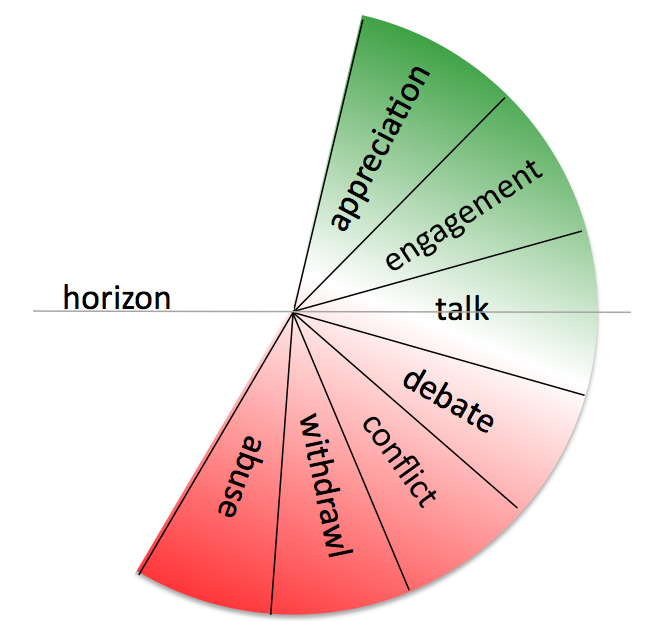
Appreciation is arguably the noblest form of communication. Too often, workplace communication focuses on fault-finding – concentrating on what is wrong, rather than what is right. When people are frequently criticised, over time they cease any meaningful communication with those who are criticising. This creates the antithesis of learning. In an environment of appreciation, people feel safe to make suggestions. Here is a link to an earlier post that elaborates on appreciation.

the communication spectrum

7. Undercover boss

The TV show Undercover Boss features businesses in the U.K., the U.S. and Australia. Across diverse businesses in these three settings, a consistent experience emerges – when the “boss” gets to know the people on the front line, they typically learn to appreciate what the workers do and return to their C.E. role much better for the experience. The C.E.s often enact employee suggestions, or include the employee in a project team. Here is Directv’s C.E. Mike White, talking about his undercover boss experience.

8. Learning from customers with social media

When I wrote this post about social media in February, this year, Stabucks Facebook page had almost 20 million likes. Now, 11 months later it has more than 26 million. Not all will provide useful insights for Starbucks, but any complaints can be quickly identified. Twitter serves the same purpose.

9. Values for learning

As with any other sustainable development in businesses and communities, better learning processes are underpinned by enabling values. Values that align well with learning include openness, honesty, integrity and appreciation. They are also the antidotes for defensiveness. You can probably think of others.

Do you consider your organisation is skilled at organisational learning?

Learning as a foundation for engagement – part two

From part one of this series, it is evident that the concept of organisational learning has been around for decades. But it doesn’t appear to have made much impact. For me there are two primary reasons:

  1. embedded defensiveness
  2. over-complicated prescriptions

1. Embedded defensiveness

Shooting the messenger is a practice that in earlier days manifest itself in physical violence and persists today, usually in more subtle punishments. In Shakespeare’s Anthony and Cleopatra, the Egyptian Queen threatens violence to the messenger that informs her of Antony’s wedding.

The space shuttle Challenger exploding

It is notable, however, that death and injury can still be caused by poor engagement and defensiveness. The explosion that destroyed the space shuttle Challenger in 1986 can be attributed to organisational defensiveness and a lack of engagement. The Roger’s Commission found that the issue with the o-rings, that caused the disaster, had been know since 1977. The 1986 launch proceeded, despite the unheeded warnings of those who believed the o-rings might fail due to the unseasonably cold weather.

More recently, and closer to home in New Zealand, the Pike River mining disaster appears to be reveal another example of poor learning through organisational defensiveness. On 19 November 2010, a massive explosion killed 29 miners in the Pike River mine. A year later, testimonies from the resulting Royal Commission of Inquiry are revealing how industry insiders were concerned about conditions in the mine in the weeks before the explosion. A Japanese mining expert, Masaoki Nishioka, told the Royal Commission that he advised the mine’s management of his concern’s about the safety of the mine before leaving the mine on October 20. Bernie Monk, whose son died in the mine has found some consolation in that miners are not not so scared to stand up and raise concerns.

In both the cases of the Challenger and Pike River Mine, a common element is the decision makers not wanting to hear news that would impede the progress of their plans.

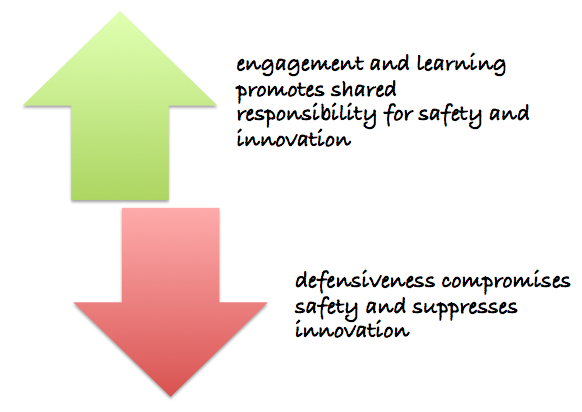
These are the extreme and public cases of defensiveness. But it manifests itself in many organisations and is the main impediment to better learning. When manifested as the “I know best” attitude, defensiveness suppresses beneficial ideas from the organisation’s rank and file that might reduce costs or spawn innovations. The MacLeod Report, Engaging for Success articulates the link between innovation and engagement:

Gallup indicate that higher levels of engagement are strongly related to higher levels of innovation. Fifty-nine per cent of engaged employees say that their job brings out their most creative ideas against only three per cent of disengaged employees. (page 12)

the downside of defensiveness and the upside of learning and engagement

Over-complicated prescriptions for learning

Many books have been written about organisational learning, typically offering complex tools and methods to achieve learning. Professional development efforts to implement these ideas are first invested in senior staff, and often the initiatives fail to gain traction further down the hierarchy. Perhaps the tyranny of defensiveness sabotages efforts?  Harvard’s Amy Edmondson comments on this phenomena in this excellent video:

First, many of the early discussions of the learning organization were abstract and without concrete prescriptions for action. Second, the concept is really aimed at the CEO, or other C-level executives, rather than local leaders who are leading focussed work … in the organisation itself – where the real critical work of the organization is done…

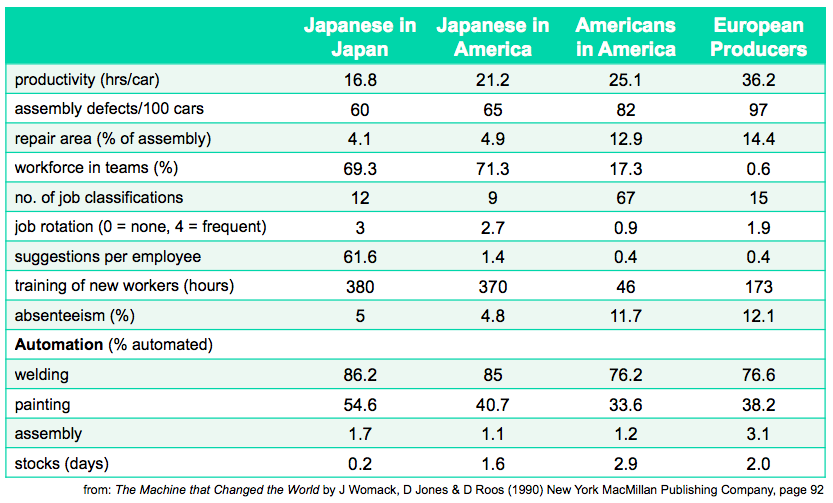
It appears that Japanese companies learned to democratise learning decades ago, while Western companies are still struggling to embed learning processes. The diagram below reveals the extent that learning is embedded in Japanese automobile assembly plants. Note that the suggestions generated by Japanese workers far exceed those from Americans and Europeans. (click on the image for a larger version)

Practical tools for engendering learning will be explored in the next post in this series. I would love to hear examples of how defensiveness or over-complication has impeded learning in organisations you are familiar with.

Learning as a foundation for engagement (part one)

Four organisational capabilities support internal and external stakeholder engagement – leadership, organisational learning, communication and adaptive capacity (or change). This post examines the strong links between organisational learning and engagement.

The discipline of organisational learning has been around for a long time, but does not appear to have gained much traction. I suspect, as engagement practices become more mainstream, organisational learning will receive renewed interest.

The emergence of organisational learning

Bob Garratt, in his book The Learning Organisation provides a “personal history of the development of the learning organisation concept“. He traces its beginnings back to thinkers such as Reg Revans, Fritz Schumacher (author of Small is Beautiful) and Jacob Bronowski (author of the BBC Series The Ascent of Man) at the end of the Second World War. Bob Garratt positions organisational learning as part of the softer side of management theory, paralleling the more hard-edged analytical management theory. 

(image of Bob Garratt from http://geniusmethods.com/about/panel-of-specialists)

The concept of organisational learning is hard to pin down, but should never be over-complicated. I regard it as the ability of an organisation to create a culture to enable it to learn from its stakeholders.

Key ideas

Learning about organisational learning theory in the absence of practical application can make it unnecessarily complex. So here, we will look at a few more key ideas about the learning organisation. These will make more sense as you apply them to your experience. The ideas here are adapted from Bob Garratt’s The Learning Organisation. Note that he first wrote this in 1987. I am impressed that the ideas he expressed align nicely with Rosabeth Moss Kanter’s research described in Supercorps (more about this later).

1. Organisations are complex adaptive human systems – not mindless machines. 

“It is first essential to break the predominant managerial and directorial mindset that human organisations are rational emotionless data-logic driven machines which stay resolutely on carefully planned and pre-determined tracks regardless of the changing environment…” (page 12)

While the physical sciences accepted Einstein’s relativism as representing a more complete picture of our universe, the management mindset seems to stick with a more clockwork Newtonian view of the world. Perhaps it is because rational systems are easier to manage than human dynamics. Bob Garratt refers to biology’s complex adaptive systems as a guide for working with people and organisations. Peter Senge reinforces this, stating that we need to “stop thinking like mechanics and start acting like gardeners”.

2. Organisations driven more by processes than structures. 

The hierarchical structures developed to facilitate production in the industrial age often hinder information age companies. Departmental structures often become silos that hinder necessary organisational processes, especially flows of communication and knowledge.

3. Learn from your learning and understand our learning processes

Often we are so busy that we fail to integrate reflection and learning into the process. Managers that do this often implement knee-jerk actions in their desperation to fix things. Another trap that organisations fall into is making universal changes, that, of necessity, require a huge investment in their success. Bob Garratt advocates taking small steps and learning from those actions. This is the basis of “action learning” – we will look at that in more depth later. As with other organisational learning writer’s, Bob Garratt acknowledges the importance of double loop learning articulated by Chris Argyris. This website provides a clear explanation of the concept.

4. Creating a learning culture 

In a culture that encourages learning, people feel safe about sharing information, confident there will not be unfair retaliation. And it goes further than that – people know that their ideas are valued, and they, when they make suggestions, they are truly heard, not just being patronised. The culture has specific practices to foster learning and to guard against undue defensiveness.

5. External adaptation

Edgar Schein identifies that how organisations adapt to the external environment, shapes the culture. Organisations that learn effectively are highly adaptive and rather than develop a siege mentality, are actively engaged with stakeholders. Thus, threats can quickly be reframed as opportunities.

6. Embracing lifelong learning 

Learning has to be encultured at all levels of the organisation, from new hires right through to the board. Bob Garratt (also the author of The Fish Rots From the Head) emphasises the need for board members to engage in learning, rather than seeing themselves as a “completed work”. A “humble posture of learning” is required at all levels.

The link between organisational learning and stakeholder engagement

By now, the link between organisational learning and stakeholder engagement will be very clear to you. Contrast an organisation who has a defensive leader, who even struggles to trust his closest advisers, to an organisation that strives to have clear lines of communication from its “central nervous system” out to an ever-expanding network of stakeholders. A metaphor might be the difference between a fence post in the ground (treated with chemicals to resist decomposing organisms, and, on the other hand, the root system of a vigorously growing tree, whose rootlets are weaving its way ever-more deeply and broadly into the soil (see the post Fence post or tree – a metaphor for engagement).

The concepts of organisational learning, first articulated over half a century ago, diverge beautifully with many other aspirations for effective organisations that honour their stakeholders. Organisational learning therefore, shouldn’t be regarded as a narrow discipline, but rather, should be regarded as a set of principles that integrate into expressions of good practice.

To conclude this topic, here is a video of Rosabeth Moss Kanter, talking about her book Supercorp. While it does not specifically talk about organisational learning, how do you think it relates to some of the concepts discussed here?

Peter Bruce

More reflections on blogging

I have been blogging now, consistently for most of this year. I am starting to see the fruits of my labour as the search engines seem now to have discovered my blog.

Blogging as exploration and inquiry

I have been a student for most of my life, completing my formal education just a few years ago. Some of my experiences as a student were intense learning experiences, and most of what I learned was relevant. Blogging has been at least as intense as any formal learning. Why is this so?

While blogging, the central themes of stakeholder engagement and sustainability dominate, but I reference back to other disciplines that underpin them, such as communication, organisational learning and leadership, and from this mix, explore the world laterally and align areas of inquiry with these central themes and disciplines. For me, it has created intellectual discipline and a space for creativity that has enabled the generation of new ideas. The Communication Spectrum is a good example of the fruit of this process. I also enjoyed exploration of relevant “big picture” stuff, such as The End of Empires.

I am a Tom Peters fan. He has sold millions of books and started blogging in August 2006. In this video with Seth Godin he raves (as only Tom can rave) about blogging:

No single thing in the past 15 years professionally, has been more important than blogging. It has changed my life; It has changed my perspective; It has changed my intellectual outlook; It has changed my emotional outlook… and its the best damn marketing tool I have ever had.

While I am yet to harvest the benefits of marketing, I thoroughly endorse Tom’s comments.

Finding voice

In the same video, Seth Godin identifies blogging as a “free micro-publishing tool” and stresses its importance as a platform for people to express their voice and join conversations. Thus blogging is an essential engagement tool.

Given blogging’s potential to support intellectual inquiry and to provide a ubiquitous platform for voice, imagine the impact it will have on our world as it becomes more common. I believe it will, alongside a host of other democratising influences, provide great impetus for beneficial social change and the development of more cohesive communities.

If you lead an organisation, or are in an influential senior position, I hope you are blogging – it can only improve engagement.