Leadership for our fragile oasis

Last week the NASA astronaut Ron Garan, and the great Muhammad Yunus addressed the Global Social Business Summit. They conveyed a similar message, but from totally different perspectives. Ron Garan is one of those elite who have seen the planet from the outside, and as with several of his peers, the experience had a transformational impact. They see things from a new perspective – the “orbital perspective”. Svetlana Savitskaya, the first woman to walk in space expressed it this way:

When in orbit, one thinks of the whole of the earth rather than one’s country, as one’s home.

At the conclusion of his talk, Ron Garan presented a spectacular video of the return to earth of his spacecraft, Soyez TMA-21 in September this year. Here is a short segment from YouTube. (The music is Peter Gabriel’s Down to Earth).

Soyez TMA-21 re-entry 

Muhummad Yunus connected back to Ron’s talk beautifully stating how it is an “unfortunate thing that we can’t keep this home as a home for a happy family”. He then spoke about the worm’s eye perspective. When he returned to Bangladesh from study in the United States, his country was experiencing warfare and famine. He found his economic theories hollow and impotent in the face of human tragedy. When he went to the neighbouring village he learned about life from the ground level – the worm’s eye view. Here he is explaining the concept.

The bigger you grow – the more distant you get away from the ground level.

Muhammad Yunus’s strength is his ability to operate from both perspectives.

Following Ron Garan’s space experiences he has dedicated his efforts to improving life back here on earth. He is a member of Engineers Without Borders, the founder of both the Manna Energy Foundation and Fragile Oasis.

Although Ron Garan adopted the posture of a student before the master (Muhammad Yunus), both men epitomise the quality of leadership required for our “fragile oasis”.

The higher ambition leader

On reading Harvard Business Review’s September 2011 article, The Higher Ambition Leader, I am struck with the parallels to the concepts championed by Muhammad Yunus and Ron Garan. The article extols the leadership by CEOs of companies such as Standard Chartered, an international bank. The bank’s vision is to be “the world’s best international bank” by “combining global reach with deep local knowledge to become the ‘right partner’ for its customers”.

The article is centred on studies of three companies whose CEOs manifest higher ambition:

to create long-term economic value, generate wider benefits for society, and build robust social capital within their organizations all at once.

These lofty ideals are achieved through creating powerful strategic visions, world class levels of engagement and a constant leadership focus on achieving the strategy.

The link to engagement

The examples of Ron Garan and Muhammad Yunus, alongside the three companies featured in the HBR article illustrate the importance of engagement. Campbell Soup’s CEO “relentlessly drove progress on two measures: total shareholder returns and the level of employee engagement”. Employee engagement levels at Campbell Soup exceeded Gallup’s benchmark of 10:1 for world-class engagement. By 2010 the company achieved “a ratio of 17 engaged employees for every actively disengaged one”. Is it a coincidence that, for the six years up to 2010 Campbell Soup achieved a cumulative total shareholder return of 64% (S&P packaged food index return is 38% and the S&P 500 return is 13%)? I don’t think so.

The leadership described here is becoming the default standard of leadership. We need leaders with both the worm’s eye view and the orbital perspective – those who can focus on the needs of their communities and companies, while also committing to sustaining our fragile oasis and its communities.


Stakeholder engagement pays – indirect benefits

With the new year looming, smart companies are considering their development options for the coming year. The smartest will be looking to further develop their engagement capacity. In an earlier post, we looked at the direct benefits of engagement. Here is a sample of some of the indirect benefits of engagement for each of the main stakeholder groups.

I emphasise that this is just a sample of the increasing evidence of the efficacy of stakeholder engagement. These indirect benefits are those that aren’t immediately visible in the bottom line, but over time provide tangible benefits for the organisation and its stakeholders.

Indirect benefits – financiers

The seismic financial shocks that rocked the world in the latter years of the first decade of this century have been devastating for financiers. And it looks like they will continue for some time. According to the Daily Mail, in a week in August 2011, three trillion dollars was wiped off the value of global sharemarkets.

While engagement itself, will not remedy the volatility of investments, it has huge potential to soften future impacts – if you factor in the ethos underpinning engagement. For example, the U.S., banks that gorged on cheap finance, distributed it with insufficient due diligence and then on-sold them to other banks. Banks with an engagement ethos would balance their profit motive with the interests of all stakeholders. Our recent experience demonstrates how a singular focus on profit creates a series of compounding negative consequences.

New McMansions are demolished in Victorville, CA earlier this year to free the city from liability resulting from possible vandalism, crime and fire danger. (LA Times photo)from Sprawled Out.

Indirect benefits – employees

Rudy Karsen and Kevin Kruse’s book We, reveals strong links between effective employee engagement and benefits to employee health and family life. They cite a study from Iowa that found that job stresses on one partner in a relationship creates a similar level of stress for their spouse. Similar effects were found for children. The British medical journal found that dissatisfied workers were 2.4 times more likely to die from a cardiac event.

Indirect benefits – customers

The most obvious benefit from customer engagement is that engaged front line staff generate better ambiance and customer experience. And brand loyalty is built through engagement. According to Tom Peters, women don’t just buy brands, they join them. If a company is able to facilitate connections between female consumers it also connects them to the brand.  Tom claims that women tend to be more relational in their purchasing, and he stresses that the purchasing power of women continues to climb.

Indirect benefits – suppliers

Over the last few decades, the attention of consumers and NGOs has shone light into the dark places of the global supply chain, often revealing shocking abuses. Engagement has enabled consumers to learn more about the conditions people suffer when growing, harvesting or extracting resources and processing them for wealthier markets. Initiatives such as Fair Trade and Sustainability Standards have generated huge benefits for disadvantaged communities. Participating companies benefit from enhanced reputation. Technology such as the Internet and satellites makes it difficult to hide. Satellite images revealed the true extent of the gulf oil spill, debunking the claims of those who sought to minimise it.

Indirect benefits – community

All of the above impacts on the community.

Pepsico have recently partnered with USAID, the United Nations Food Programme and 10,000 Ethiopian farmers to grow chickpeas. They will be used for food supplements for the starving, for the local Ethiopian market and for Pepsico’s humus. Multiple community benefits will accrue. For example, the health of Pepsico’s range of brands will be improved with the greater use of chickpeas. This aligns with another initiative from the company to reduce levels of saturated fat, sugar and sodium in their food. There are anticipated flow on effects to the health of consumers.

I welcome any comments about indirect benefits of engagement that you have encountered.

Pepsico, Ethiopia and chickpeas – a win-win-win

Pepsico are engaging with partners and the Ethiopian Government in an initiative to improve chickpea production. Chickpeas are an ideal crop – they grow well in Ethiopia, the have great nutritional values, including high protein and, being a legume, help build soil fertility.

Chickpeas – image credit and history of human use

The plight of the poor in Ethiopa rarely comes to our attention – it has to compete with our fixation on the economy and other more pressing news. Ethiopia is currently experiencing another drought and famine. And Ethopian resources are further stretched as refugees continue to flood in from its drought and war afflicted neighbour, Somalia,

Pepsico, in partnership with USAID, and the UN World Food Programme, will work with 10,000 farmers in Ethiopia to help them reap a twofold increase in sustainable chickpea production using irrigation and advanced agricultural practices. Other partners include the Stellenbosch University in South Africa. The increased volume of chickpeas will have three markets:

  • the World Food Programme will produce a locally sourced nutrient-rich, ready-to-use supplementary food to address malnutrition initially targeting 40,000 Ethiopian children
  • local commercial uses in Ethiopia
  • expansion of Pepsico’s hummus offerings.

This is a great example of the good that companies such as Pepsico can generate as they build their own internal awareness of the plight of the world and the interconnectedness of the systems that sustain us. The cynical might deny the element of altruism, that I believe, is undeniably manifest in Pepsico’s thinking. (This earlier post discusses altruism as a sustainability driver).

“With the ingenuity, power and reach of the private sector, we can make great strides in ending the malnutrition and hunger that is threatening the lives of millions,” said Josette Sheeran, Executive Director of WFP. “The world knows how to prevent malnutrition. The hunger we are witnessing today in the Horn of Africa is preventable with local solutions that support small farmers in being part of the solution. Enterprise EthioPEA will change the lives of tens of thousands of children and will chart the course for future partnerships to help stamp out hunger around the globe.” (from the Pepsico website)

Among the evidence of Pepsico’s intent is the partners it chooses to work with, and the people it employs to champion such projects. Here is a video featuring Derek Yach, the current the Senior Vice President, Global Health and Agricultural Policy, PepsiCo Inc. He was previously the Professor of Global Health at Yale School of Public Health, and Executive Director of the Noncommunicable Diseases and Mental Health cluster at the World Health Organization (WHO). In the video he elaborates on the project.

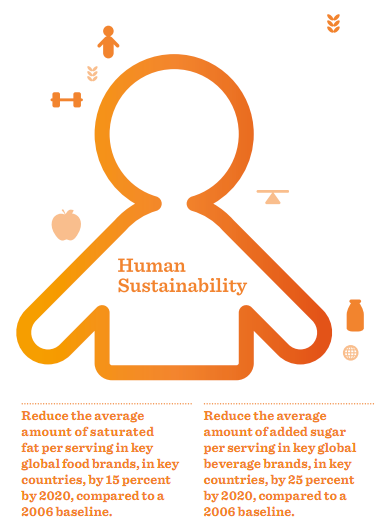
Pepsico are also aware of the health risks that many of their products pose back home. Their 2010 sustainability report includes goals to reduce the quantities of saturated fat, sugar and sodium in their products.

from the Pepsico Sustainability Report

Derek Yachs believes that the future of Africa depends initially on more effective and sustainable agriculture. This quality of thinking and effective engagement with partners will see corporates such as Pepsico transform the global economy and society.

Stakeholder engagement pays – a silver bullet?

Effective stakeholder engagement contributes both directly and indirectly to the bottom line. This post provides a sample of some proven benefits of stakeholder engagement for the major stakeholder groups. What is exciting, is that the generic communication skills at the heart of engagement are effective in diverse stakeholder settings. Surely engagement capability has to be a top priority for organisational development.

Some of the examples here have been in other posts – they are assembled here to demonstrate the multiple benefits of stakeholder engagement.

Financiers

Companies with better CSR performance “face significantly lower capital constraints”. Beiting Cheng, Ioannis Ioannou and George Serafin’s research, Corporate Social Responsibility and Access to Finance, confirms their hypothesis that:

…better access to finance can be attributed to reduced agency costs, due to enhanced stakeholder engagement through CSR and reduced informational asymmetries, due to increased transparency through non-financial reporting.

Employees

An impressive array of research and anecdotal reporting evidences the vital importance of effective employee engagement. Here are a couple of examples:

  • David McLeod, in a report to the British government in 2008 estimated the cost to the UK economy of their low levels of engagement to be between £59 and £65 billion pounds.
  • Recent Gallup research identified a high correlation between effective engagement and high earnings per share (eps). Companies with “exceptional employee engagement” achieved eps more than four times that of their industry competitors.

By engaging employers, companies are engaging their engagers.

Customers

Gallup also provide impressive figures for those companies that engage effectively with customers.

Our studies reveal that customers who are fully engaged represent an average 23% premium in terms of share of wallet, profitability, revenue, and relationship growth than the average customer. Actively disengaged customers represent a 13% discount in those same measures.

Suppliers

This video from Walmart reveals efficiencies generated by the partnership between the company and Peterbilt, who supply trucks. The partnership is helping Walmart to achieve its target of a 100% increase in transport efficiency by 2015 from a 2005 baseline.

While I can’t support this anecdotal evidence with figures, the director of a local company attributes an effective relationship with suppliers with the survival of his company. When the company was experiencing difficulties, several suppliers extended credit to help the company through.

Community

Witold Henisz led a major Wharton School research project delivering evidence of the financial benefits of effective stakeholder engagement in gold mines in Spinning Gold: The Financial Returns to External Stakeholder Engagement. The research team studied the impact of stakeholder engagement on the financial performance of gold mines and gold mining companies. They created an index based on 50,000 stakeholder events from the activity of 26 gold mines.

By incorporating this index in a market capitalization analysis, we reduce the discount placed by financial markets on the net present value of the gold controlled by these firms from 72 to between 33 and 12 percent.

Increased productivity of the effective engagers where able to start mining earlier than poor engagers. You can read more about this here.

This is just a sample of the increasing evidence of the efficacy of stakeholder engagement. Please add any others as a comment.

Engagement and change: part 2 – lean thinking

This post by guest blogger Alex Twigg is the second part of a two-part post.

Much of the change in workplaces over the last few decades has been predicated on notions of economic efficiency and have been known variously as “downsizing”, “rightsizing”, “outsourcing” and more recently as “mergers and acquisitions” – and as the Kotter and McKinsey studies mentioned in part one shows – not much of it successful. In the February / March edition of the Harvard Business Review, an article on mergers and acquisitions quotes the following – “Companies spend more than $2 trillion on acquisitions every year, yet the M&A failure rate is between 70% and 90%.”

By contrast, an alternative model of change – one that is intrinsically engaging of employees, that is about “learning to do things with others” is a workplace transformation process known as Lean Thinking – a western lens on the Toyota Production System.

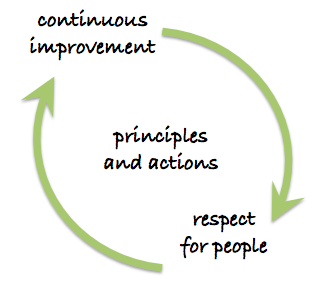
The ‘lean” or “less” of Lean Thinking is often misunderstood. It is not about cost cutting (the old traditional focus of change) and it is certainly not about retrenching – i.e. less staff. Rather Lean Thinking is based on two values: continuous improvement and respect for people. The system of “lean thinking” is the mutual reinforcing of these twin values through a structured process of principles and actions – that in its essence is fundamentally engaging of employees.

Reducing waste

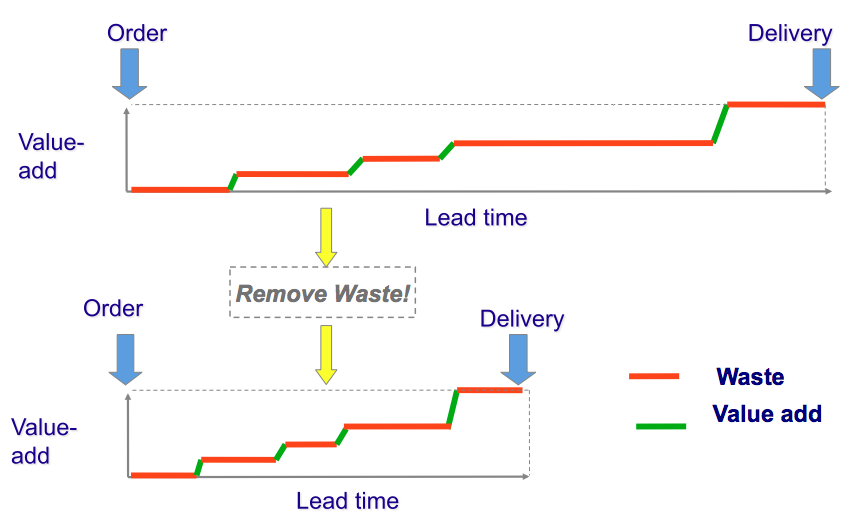
Lean Thinking is not premised on the assumptions of “economies of scale” and its twin “resource optimisation” – the assumptions that shape traditional approaches to organisational change. Rather it focuses on a notion called “flow” and the removal of waste. It is primarily focussed on process efficiency rather than economic efficiency.

The traditional approaches to change and Lean Thinking depend on very different primary sources of data to inform change. In the former the data derives from an abstraction of the productive process – namely the organisation’s statements of account. The primary question in this approach is “how do we make the economic equation of this organisation work?” This is the question that has shaped all the “”downsizing” “rightsizing and “mergers and acquisitions” activity of the past. In “lean” the primary source of data for change is from the organisation’s productive processes themselves – through the identification and removal of waste to answer the primary question of “how do we make value flow?”

Lean Thinking identifies 7 forms of waste, namely motion, waiting, transportation, storage, defect waste, over producing and excessive processing. Space precludes a discussion of each of them me so for present purposes a description of the first will have to suffice as a sense of the thinking behind waste generally.

Motion waste consists of all unnecessary movement and searching. Searching is the biggest form of motion waste – searching for information, looking for the correct person, tool or document. It is estimated that between 20 – 50% of time in a physical workplace is spent looking for people, tools, specifications, patient information … and in an office environment, some 15% of our time is spent looking for information that is within an arm’s length! In addition to searching, motion waste includes all unnecessary bending, lifting, reaching and walking. 

To systematically remove waste from an organisation’s processes requires the active involvement of the employees who are uniquely positioned to see the waste. Managers cannot see deep enough into the processes to really identify the waste that the employees see and experience daily.

This creates a dilemma for organisations – managers have the authority to effect change but not the complete awareness required on which to base this change; and employees by contrast have the awareness but not the authority.

The employee engagement strategy to Lean Thinking is to structure a process that seeks to resolve this dilemma. It requires 2 guarantees to give it meaning – one procedural, namely participation by all in identifying waste – the other substantive – no redundancies as a result of lean initiatives. The former is essential to identify and remove waste. And the latter is required otherwise employees won’t participate. Clearly no-one will participate in identifying waste if their jobs are put on the line as a result – and flow cannot be improved if employees do not participate in identifying waste.

The central component of a change process premised on employee engagement is a closed loop feedback system for responding to and implementing employee generated suggestions for improvement based on identifying and reducing waste. This is nothing like the good old suggestion box though on the surface it may appear similar.

This system is built on a structured process of organisational learning that teaches the organisation the following:

  • value stream mapping skills that allows everyone to see the organisation’s current end to end process to providing its services or manufacturing its goods, as well as imagine an improved future state. This creates a framework for employees to think about and identify the effects of waste that they experience everyday at work.
  • root cause analysis skills that allows everyone to identify the causes behind the effects of waste that they experience everyday at work as frustrations, irritations, inefficiencies etc.
  • developing the systems and processes – the architecture if you will – of this transparent, closed loop system that allows people to see that the individual opportunities for improvement they have raised have been captured, and how and who is able to participate in addressing them.

Removing waste reduces lead time enabling more resources to be
dedicated to adding value

When this process is introduced in workplaces it results in literally hundreds of employee identified “Opportunities for Improvement” or OFIs.

If one is looking for a measure of employee engagement, how good is this one? Surely this is a direct expression of an employee’s commitment to an organisation? And very importantly it is a measure that arises directly from every employees work – i.e. their involvement in the organisation’s processes rather than arising indirectly – i.e. from something external to their everyday work – like completing a survey that creates a new bureaucratic structure that adds little or nothing to either the flow of goods and services through an organisation or the flow of problem solving in the organisation.

Lean thinking is an example of the sort of workplace improvement strategy that the Department of Labour is supporting through its High Performance Working Initiative.  You can find out more about this at www.dol.govt.nz/er/bestpractice/hpwi/index.asp

Guest blogger: Alex Twigg

Alex Twigg presented at the recent HRINZ National Conference in 2011. He has extensive experience in employment relations (ER) in a variety of roles including mediation, arbitration, advocacy, facilitator and process consultant. Over the last four years he shifted from operational to strategic ER – focusing on the link between people, process and organisational performance.

Alexander is currently employed by the Department of Labour’s Partnership Resource Centre.  He works with unionised workplaces helping the parties improve their workplace relationships and then help them put those relationships to work using frameworks such as ‘Lean Thinking’ to help both parties achieve their mutual and separate interests.

Employee engagement and change – part one

When thinking about employee engagement I am struck by the how similar the employee engagement scores are from around the English speaking world. The results are all similarly low – around the 25 – 30 % mark. And it seems little really changes year after year.

The costs of low engagement and ineffective change management

David McLeod, in a report to the British government in 2008 estimated the cost to the UK economy of their low levels of engagement to be between £59 and £65 billion pounds. But low levels of engagement not only have an economic cost; it also deprives employees an opportunity to find meaning, dignity and community in work. This is the social cost; as yet unmeasured but equally important and perhaps even larger than the economic cost.

But these costs say nothing about the cause or the solution to these perennially low levels of employee engagement. I believe the cause of the problem is hinted at by another well known workplace statistic. Many will be familiar with John Kotter’s research findings in 1996 that 70% of organisational change fails to achieve its objective. Fewer might be familiar with McKinsey & Co’s study in 2008. It showed little improvement over the 12 years between the 2 pieces of research notwithstanding the focus change management skills and practice has received over this period.

What’s going on here? Is there something about the way we effect organisational change that inhibits or undermines employee engagement? If we shift our focus from trying to change employee engagement scores to changing the way we effect organisational change might we improve both?

I think that if we want to see employee engagement scores increase we need to turn our attention to focussing on an approach to managing change that is intrinsically engaging of employees.  In short I think we need to change the way we think about and give effect to organisational change.

Effective change

So what’s wrong with the traditional approach and what does an alternative model of change look like? We seem to be currently addicted to an approach to change that is predicated on notions of expert knowledge and its association with management control, what Marvin Weisbord calls “learning to do things to or for others” as opposed to “learning to do things with others”.

The traditional model of change is typically one of a few people, mostly managers (at times working with consultants), who generate change proposals and consult with employees affected by the proposal. A common feature of this sort of change is the short period of time employees and their representatives are given to comment on the proposals relative to the time taken by managers and their representatives, to develop the proposals. If the adage Kathleen Dannemiller and her colleagues articulate in their thinking about workplace change is correct – namely that “we commit to the things we help to create” is true –then its little wonder that our levels of employee engagement – a measure of our employees commitment to their organisation, is so low.

This article was first published in the August/September issue of the Human Resources magazine. Part two explores practical means of improving engagement and adaptive capacity for change.

Guest blogger: Alex Twigg

Alex Twigg presented at the recent HRINZ National Conference in 2011. He has extensive experience in employment relations (ER) in a variety of roles including mediation, arbitration, advocacy, facilitator and process consultant. Over the last four years he shifted from operational to strategic ER – focusing on the link between people, process and organisational performance.

Alexander is currently employed by the Department of Labour’s Partnership Resource Centre.  He works with unionised workplaces helping the parties improve their workplace relationships and then help them put those relationships to work using frameworks such as ‘Lean Thinking’ to help both parties achieve their mutual and separate interests.

Engaging a nation: lessons from the Rugby World Cup

In 2005, when New Zealand won hosting rights for the 2011 Rugby World Cup the negotiators had promised the event would be supported by a stadium of 4½  million – New Zealand’s population. They were confident – rugby is embedded into New Zealand culture and for many New Zealanders it is an integral part of who we are. The All Blacks are established as a strong rugby brand, both domestically and internationally.

Economically, New Zealand is marginal as a host country as the population doesn’t support large stadia and the New Zealand Rugby Union is facing a significant financial loss.

image credit: Daily Mail, U.K.

But the World Cup has been a massive success because of the engagement of the nation. In the days leading up to the tournament’s opening flash mob haka happened around New Zealand and other parts of the world. And here’s cell phone video of “flash waiata” as a group of young men make their way to the Fan Zone. The opening ceremony was stunning. For me, even more impressive was the co-ordination of fireworks, container cranes, an orchestra, pipe band, singers and musicians at multiple locations around the Auckland waterfront in a stunning follow up to the opening ceremony. The lyrics of the song “All lit up”, (7.50 minutes into the opening ceremony video) delivered by a choir at the top of a high rise, accompanied by the New Zealand Symphony Orchestra, speaks to me of a cultural shift in our nation:

I used to try not to stand out.
I used to try not to talk too loud.
Now every one can see
What’s come over me
I’m all lit up…

And fans turned out to neutral games in cities around the country and adopted teams to support.

Working together

The success of the tournament is based on the effective collaboration of a multitude of partners, including the International Rugby Board, the national and local rugby boards, national and local government, and many others. The organisers have forged a network of collaborators and created a range of events to support the tournament. The synergy between the core rugby events and a diverse range of other events throughout the country helped to build excitement, energy and a sense of connection. The Real New Zealand Festival, co-ordinated events throughout the country.

Visitors to the country have been fulsome in their praise of the event and the hospitality experienced in New Zealand.

Lessons for business

From an engagement perspective, what lessons can we learn?

1. Create the story

Rugby is part of the DNA of our nation. The story was already there to be told. We won the inaugural World Cup in 1987, but despite being usually ranked number one in the world, we were unable to secure another win. Stories create meaning. Our impending win is not just about winning a sports tournament – it’s about national redemption. While that might appear a little melodramatic, the lesson for business is that the story generates meaning and motivation. The best businesses engage the hearts of their employees in support of a mission they get to own themselves.

2. Draw on pride

We are a small nation, but we are great at rugby. Three of the four semi-final head coaches are kiwis. Our pride is embedded in the results of the games and also in the quality of our organisation of the tournament and our hospitality. Excessive pride begets arrogance, but moderate doses of pride engage the hearts in a positive manner.

3. Create a stage to draw the diverse together

From an historical perspective, rugby has been a venue for cultural engagement. Rugby provided a cultural space for the two founding cultures of the modern New Zealand nation, Mäori and Pakeha (Europeans, mostly British) to literally rub shoulders and play together. Later arrivals from the Pacific Islands have also been integrated into the game. During decades of the downside of colonisation and assimilation, rugby has continued to provide a space for Mäori culture, with the iconic haka, the bilingual expression of our national anthem and, in this tournament, the diverse expressions of Mäori culture in events and ceremonies.

The integration of rugby and other events throughout the country has juxtaposed sports events with diverse events featuring food, drama, fashion, hunting, music and many others.

Contrast this with the perennial business problem of departmental silos. I don’t want to elaborate with examples, but the challenge is to create the stage, or create spaces for engagement with both internal and external stakeholders.

4. Ride the waves of culture change

Culture builds over time. But it isn’t a steady incline. Events provide surges of cultural influence. The combination of the success of this tournament, the quality of events, especially the opening ceremony and our inevitable victory on Sunday night instils a sense of self-belief and optimism. While we need to be realistic, at the same time, if we ride this cultural wave we can make some gains as a nation. The stories of the cup victory will become part of our cultural fabric.

Wise leaders will recognise the waves of cultural change, highlight them and celebrate them.

5. Learn from a great team

This is possibly the greatest All Black team. After our untimely exit from the previous world cup, the services of the much-maligned coaching team were retained for another four years. They appear to have produced a team environment that is supportive, but also stretches individual capabilities. There is a tangible sense of camaraderie and players ably support one another on the field. They have countered criticisms of the past by being able to change tactics on the field, with evidence of a high degree of cohesiveness between the players.

Go the mighty All Blacks.

image credit: nzbrtours.com


Engagement and the value chain

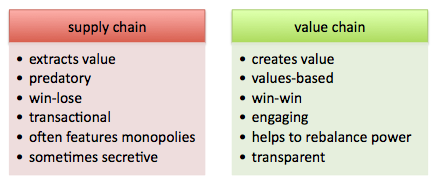
A quiet revolution is underway that is transforming business practice. For years we talked about the supply chain. Companies can do good and enhance profitability by converting their supply chains to value chains. To keep it really simple, I believe the key difference between these chains is that various parts of the supply chain seek to extract value creating winners and losers. The various stakeholders in the value chain seek to create value, and ideally, create shared value.

The graphic below contrasts the supply chain and the value chain. It deliberately polarises the two concepts to illustrate how the value chain can transform business. If you want a deeper understanding of the value chain, try Bob Willard’s blog. I am going to focus on giving some diverse examples to illustrate the how a value chain ethos can transform business and create multiple benefits.

Supply chain – parks and reserves

Going back two or three decades, most city councils in my country (New Zealand) had in-house parks and reserves departments. As financial reforms swept through the country, this function was contracted out. In the first years, the councils had a number of suppliers, but over time, using their power in the relationship, the contractors were encouraged to “sharpen their pencils” when tendering for contracts. While this was good for the ratepayers, as it drove down costs and the training infrastructure embodied in the old system was severely damaged. Now in a user pays age, staff employed by contractors, have to pay for their own training if they want qualifications.

The supply chain and value chain in gold

Here is an extract from Harriet Lamb’s Fighting the Banana Wars and Other Fair Trade Battles (page 170 – 171).

The most vulnerable people mining gold are getting ripped off, they earn absolutely nothing – and so work in the most appalling conditions…. the men go deep underground hacking out the ore. Kids as young as six then stands on a huge granite rock rolling it over the ore mixed with water and mercury, which gradually absorbs the gold.


Then these kids scoop it up with their bare hands into cut off plastic bottles and take it to their homes. There, on their kitchen stoves they evaporate the mercury, so releasing poisonous gasses, to leave the gold.

Mercury is incredibly toxic – just small amounts will kill over time. I imagine these children have to work, because their parents are busy doing the heavy work extracting the ore, and the financial returns are so poor. Do you think these people know that the price of gold has gone through the roof – probably not. I imagine that some of this gold goes to gold plating in the mansions of the opulent, or for rapper “bling”. These consumers would have no idea of the suffering they are complicit in (is that too harsh?).

The Fairtrade movement seeks to extract miners from the supply chain and embed them in a value chain. A major difference will be that those making the purchase will know the good that their purchase creates. Here is a video telling the story of Fairtrade and Fairmined gold. Note the children grinding the ore.

Walmart’s value chains

Earlier blogs have identified how Walmart is created shared value in supplier relationships with companies such as Peterbilt. The massive trucks Peterbilt sells to Walmart are at the heart of their strategy to reduce their emissions 100% by 2015. Peterbilt will benefit both from this long-term relationship with Walmart, and in creating technology to make their vehicles more environmentally friendly – probably opening up other markets.

Another value chain strategy is Walmart’s intention to reduce sugar and sodium content and eliminate transfats from the foods they sell. As they supply 25% of the food in the U.S., they benefit the consumer and the wider community by, hopefully reducing the burden on the health system. Here is Daniel Goleman commenting on the Walmart value chain.

Here are just three examples of the supply and value chain. Feel free to comment and add further examples.

image credit: http://www.officialpsds.com/Pac-Gold-Bling-Gun-PSD50321.html 

Staff engagement and the failure of HR

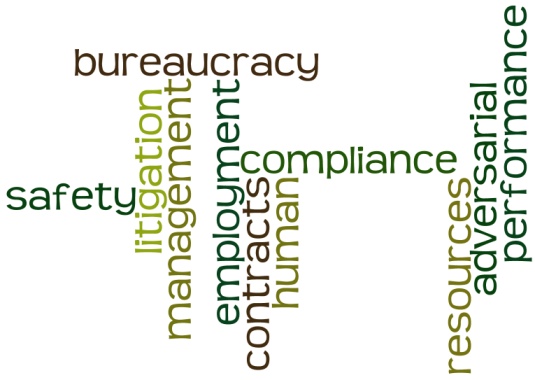
The Human Resource (HR) function has a fatal flaw in its very conception. It is a flaw that limits the ability of HR to foster better staff engagement. It is the inherently schizophrenic nature of the role – in that it has two typically contradictory functions, controlling the employment contract on the one hand, and developing the organisation and its staff on the other. These two functions sit on the shoulders of the executive like the good and evil angel, whispering contradictory messages. Keith Hammond of Fast Company is even harsher in his judgement:

The human-resources trade long ago proved itself, at best, a necessary evil – and at worst, a dark bureaucratic force that blindly enforces nonsensical rules, resists creativity, and impedes constructive change. HR is the corporate function with the greatest potential – the key driver, in theory, of business performance – and also the one that most consistently underdelivers.

The contract role

The dominant HR role in many organisations is the contract role – hiring staff, determining remuneration, and providing the structures for performance management, promotion and rewards. As employees typically represent the greatest expense in organisations, the HR function is focussed on controlling and reducing that expense. This focus engenders a litigious and adversarial mindset. Contracts are nailed down and policy and procedures proliferate. The HR function is the natural adversary for unions, and these two, often get locked into mutually destructive behaviours, as eloquently described by Peter Drucker:

Management and union may be likened to that serpent of the fables who on one body had two heads that fighting each other with poisoned fangs, killed themselves.(Peter Drucker).

I believe this has a broader impact on many organisations in fostering a “theory x” approach to management – perceiving staff as unmotivated and needing to be coerced to perform.

“All the world’s a stage…”

It is not the people themselves. The HR people I know are great people. I am sure they are nice to their children and pets, but in the organisational context, they, like most of us, become, in a Shakespearian sense, actors walking on to a stage. The stage is set, the lines prepared and action roles on from scene to scene. Over time, the financial focus that HR people become fixated on shapes their worldview. Tom Peters suggests HR are “mechanics rather than visionaries”.

Even the name is a problem. A resource is something you store until it is time to use it – like firewood in a shed. In this video Stephen Covey points out, that on balance sheets, people are represented as an expense, while machines are an investment. He calls this the paradigm of the industrial model.

HR and employee engagement

If you access an annual report, or a sustainability report, chances are, that the main strategy for employee engagement is an engagement survey. Look to see if you can find anything behind it. More often that not, in my experience, there is nothing substantial to find.

We know that surveys such as the Gallup poll reveal low levels of engagement worldwide. What would be an effective level of engagement? What percentage of staff would need to be engaged to contribute to high levels of intrinsic motivation and performance?

To improve, we have to learn from those rare companies that exemplify great engagement.

The way forward

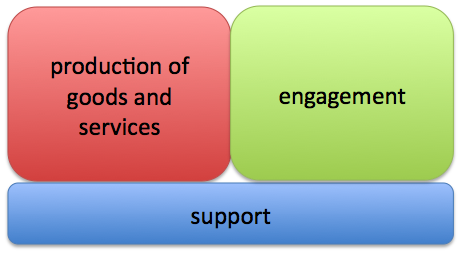
Incrementalism won’t do. I believe we need a rethink of the structure of organisations. As outlined in an earlier post, engagement needs be a core organisational capability.  By organising into three main functions, engagement, production and support, organisations are better equipped to engage with stakeholders. The engagement role can include HR, marketing, customer service and communications. Bundling them together, and heading them with an engagement champion will help to balance the contractual and developmental functions of HR.

I would love to know who, in your opinion, are exemplars of employee engagement.

Engaging stories: Fairtrade cotton

I mostly drink Fairtrade coffee, sometimes eat Fairtrade chocolate, but must confess, I don’t wear Fairtrade cotton. That will change now that I am reading Harriet Lamb’s Fighting the Banana Wars and Other Fairtrade Battles.

Struggling to stay above the poverty line

Harriet Lamb tells of cotton grower’s subsistence existence in Africa, where cotton supports about 10 million people. For countries such as Burkina Faso, cotton is the major export. Typically the growers live in villages that often don’t have direct access to drinking water, education and healthcare facilities – things we take for granted in the West.

African and other third-world cotton growers are enmeshed in the fabric of global trading dynamics. If they only had to contend with the vagaries of the weather and nature, and even the free market, they might be okay, but their problems are compounded by subsidies that wealthy countries pay their cotton growers. The U.S. Government subsidises their own cotton growers in response to falling cotton prices. When U.S. subsidies increased in 2001, U.S. growers responded by growing more cotton. Not, surprisingly, increased production saw the global price fall further. In 2005, the U.S. Government spent $4.7 billion on cotton subsidies, more than it spent on aid to Africa.

We also have spare a thought for the U.S. taxpayer here. The Government’s subsidies distort the market and impoverish parts of Africa, impelling Western governments to provide aid – so the U.S. taxpayer pays twice – through cotton subsidies and through aid. And it is even more crazy when the US subsidises Brazilian cotton farmers as part of a free trade deal. Unfortunately the Africans don’t have a free trade deal! The Fairtrade story, teaches us that aid is less necessary when factors influencing global markets are more carefully managed for all stakeholders.

Minimum prices

Fairtrade’s main mechanism for creating better returns for growers is a minimum price. This provides a buffer for growers and with the troughs in the market cycles eliminated, growers and their communities get the cash they need to raise living standards. Typically communities will invest additional income into clean and local water supplies and education.

As important as the material improvements, is the contribution the Fairtrade ethos brings to village life. For example, Fairtrade work to raise the status of women, through the agency of additional income and education. This video about Fairtrade cotton in Cameroon features the benefits to women. One of the women outlines the benefits:

The Fairtrade standards insist that women are in the group. The men had difficulty accepting this at first but slowly they realised that it could work. And now they own their own land… they are independent. They work their land, they go and receive their money alongside the men and this motivates others to get involved as well.

Commodity price increases

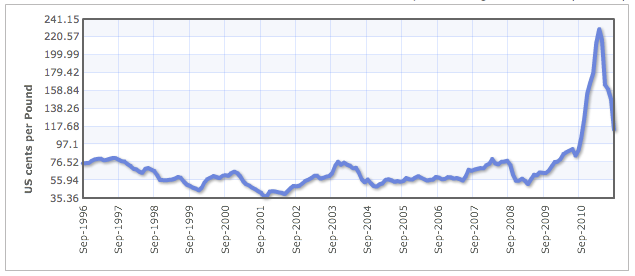
Recent spikes in commodity prices around the world have ameliorated the distortions created by subsidies. Demand for cotton has increased, as more people join the middle class, cotton production decreases and discerning consumers learn to favour natural textiles. This chart from the Index Mundi website, show the cotton price over the last fifteen years, revealing the sharp recent spike.

What I don’t know, is the impact this spike has had on third world growers. When commodity prices rise, growers don’t necessarily benefit. Has Fairtrade been able to ensure a fair share of the benefits get to those that need it most? And does it make you feel better about paying more money for a pair of jeans?