Stakeholder mapping – for threat or opportunity?

To map stakeholders, AccountAbility’s approach is to rank each stakeholder with a number of factors. This approach provides some scaffolding to enable a more objective assessment. Here is a summary of these factors from an earlier version of AccountAbility’s AA1000SES. 

  • Responsibility – the organisation has, or in the future may have, legal, financial and operational responsibilities in the form of regulations, …etc.
  • Dependency – stakeholders who are dependent on an organisationʼs activities and operations in economic or financial terms
  • Influence – stakeholders with influence or decision-making power (e.g. local authorities, shareholders, pressure groups).
  • Representation – stakeholders who through regulation, custom, or culture can legitimately claim to represent a constituency
  • Proximity – stakeholders that the organisation interacts with most, including internal stakeholders …etc
  • Policy and strategic intent – stakeholders addressed through the policies and value statements

Threat bias

Notice how the bias in these factors is towards threat rather than opportunity? Sustainability initiatives, such as stakeholder engagement have developed in the context of threat. Corporates adopted social responsibility initiatives in response to criticism of their social and environmental performance. These were rearguard and defensive actions. Programmes such as the Global Reporting Initiative (GRI) are an example. In this century, corporate are exploring sustainability initiatives as a source of innovation and competitive advantage. I described this shift in an earlier post – What is Sustainability 2.0?
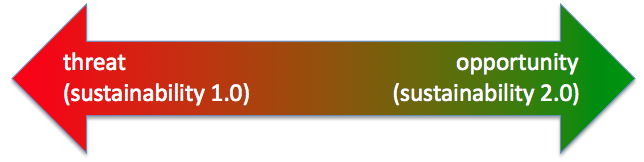
If your organisation wants to express its sustainability initiatives as an opportunity, it would pay to change the factors used in stakeholder mapping to, at least, balance opportunity and threat.

This can be achieved in a number of ways:

  • creating a higher weighting for opportunity factors
  • reducing or combining threat factors
  • adding opportunity factors.

For example, you might combine threat factors such as responsibility and dependency, thus halving their influence in a final rating. Adding an opportunity factor, such as “potential for creating shared value” will further shift the balance. The “shared value” factor identifies those stakeholders the organisation can work with to create shared value. An example could be using a waste product from a stakeholder as a raw material, or supporting education initiatives to upskill the local population as a potential labour force.

Anthony Robbins identifies pleasure (opportunity) and pain (threat) as two motivating forces. Avoiding pain may be a stronger motivator than moving towards pleasure. Is this the case with sustainability and stakeholder engagement? If we are responding to perceived or potential threat we will probably develop a compliance mentality – and I don’t think compliance is that motivating. I would like to think that an aspirational approach based on pursuing engagement opportunities with stakeholders is more motivational. What do you think? 
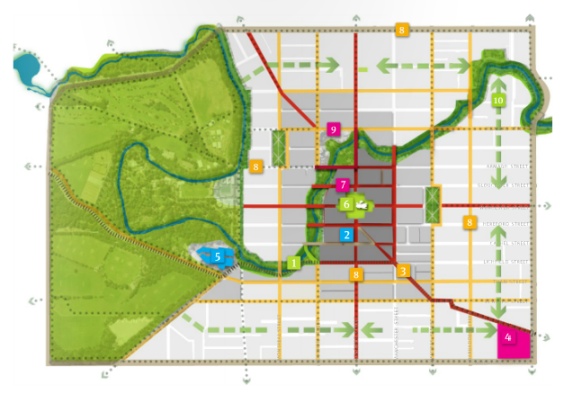
Engaging stories: rebuilding Christchurch

The City of Christchurch, New Zealand was devastated by a series of earthquakes. The largest, on the 4 September 2010 wrecked havoc in the central city, but the second quake on 22 February killed 181 people and all but destroyed the central city. The response of the people of Christchurch is an inspiring engagement story. On 11 August, the Christchurch City Council released it draft Central City Plan.  The plan was immediately received with acclaim.

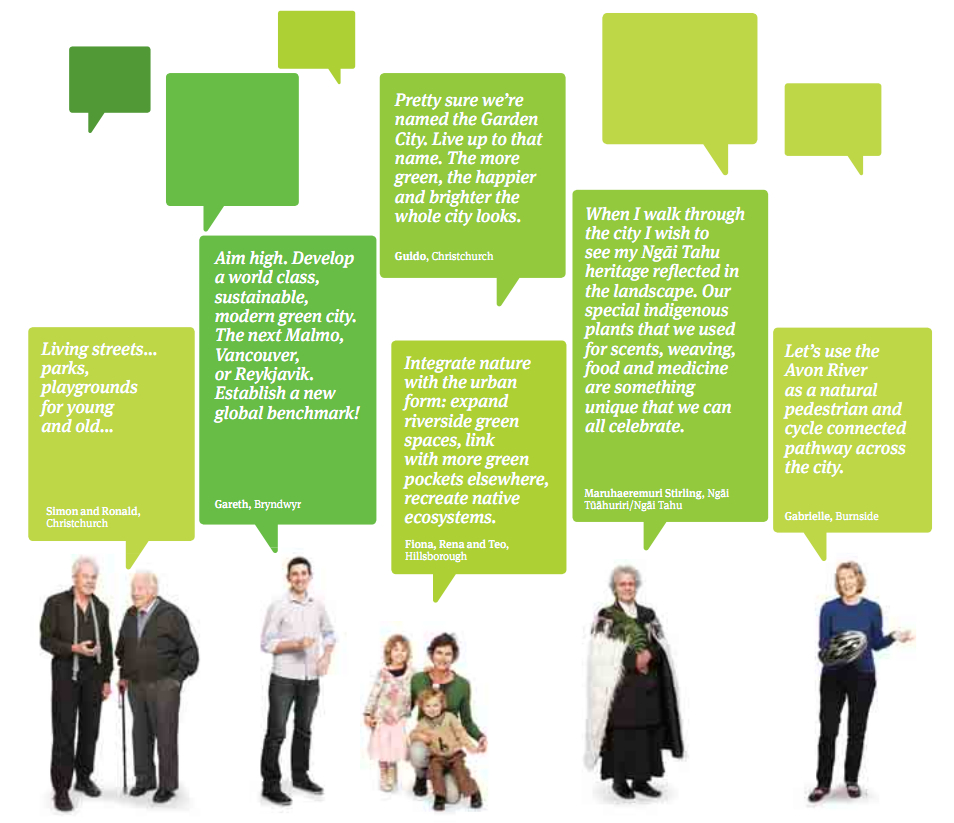
From an engagement perspective, the plan embodies three foundational strengths:

  • inspirational leadership
  • inclusion of the indigenous Ngāi Tahu
  • comprehensive public participation and community engagement

 Inspirational Leadership

From the day of the first quake, the indefatigable Mayor, Bob Parker fronted up and communicated clearly, exuding a aura of compassion and hope. As in the image below, he was often seen on camera with a person translating his words into sign language, an unspoken symbol of inclusion. When the Council released the draft plan there appeared to be an evident sense of celebration and unity in the council – not that common in local body politics.

 Inclusion of the tangata whenua

The Mäori tribe Ngāi Tahu are the indigenous people of the Canterbury region. In formal occasions, it is common for Mäori to acknowledge tipuna (ancestors) and those who have died. The draft plan beautifully incorporates words authored by Ngai Tahu to set an appropriate context for the plan. Here is the English translation:

This mihi is given by the Ngāi Tahu Rūnanga – Te Ngāi Tūāhuriri- to acknowledge and respect the people who have been lost and those whose hearts are grieving them, and the sorrow of this .  It also acknowledges the losses and pain of all people in Christchurch and Canterbury who have suffered as a result of the earthquakes.  Ngāi Tahu recognise their atua/god Rūaumoko as having pulled his umbilical cord and caused so much to break, including land from the mountains to the sea.  While acknowledging the pain, Ngāi Tahu see us uniting us as one people – the survivors (morehu) of Christchurch and Canterbury.  The mihi is a call to Christchurch to rise up, and together to rebuild Christchurch brighter and better.

Public participation – share an idea

Following the second quake, the City Council launched Share an Idea, a public engagement campaign to lay the foundations for the rebuild. In six weeks, the website, www.shareanidea.org.nz generated over 58,000 visits. Ideas were also harvested through facebook and twitter. Virtual engagement was complimented by a two-day community expo (attended by over 10,000 residents) and a series of public workshops. These are two of the larger examples of over 100 stakeholder meetings. (See the draft plan for more detail of engagement).

A total of 106,000 ideas were shared during the six week campaign – that is one idea from every 2.2 residents. Share an Idea generated a level of community involvement that has never been seen before in New Zealand.

The fruit of the engagement process

The thousands of ideas clustered into 5 themes:

  • green city
  • market city
  • city life
  • distinctive city
  • transport choice

The plan includes contributor’s comments to directly link the ideas generated to the completed draft plan (click on the thumbnail for a larger image).

Mayor Bob Parker described the new Christchurch as “a safe, sustainable, green, hi-tech, low-rise city in a garden”.

Out of adversity comes an unprecedented opportunity. We are embarking together on one of the most exciting projects ever presented to a community in New Zealand, perhaps the world…This is our city, it will rise again

Bob Parker

This is just a taste of a truly inspirational document. Anyone interested in stakeholder engagement, community participation or organisational development will benefit from a closer look.

Sustainability depth – are you green from top to bottom?

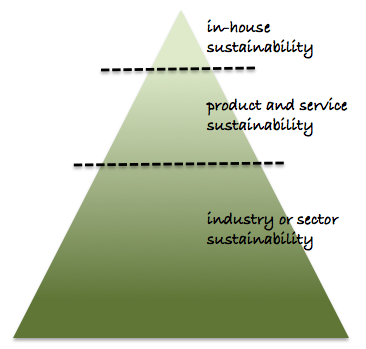
Companies trumpet sustainability initiatives, but what is the significance of these initiatives? Another lens we can use to evaluate their efforts is a measure of sustainability depth. There are three levels of performance to consider:

  • the company’s in-house sustainability performance
  • the impact of the company’s products and services on society and the planet
  • the company’s leadership role in sustainability in its industry or sector.

Lets look at examples of some industries to understand the significance of this approach.

Banking

You probably will have noticed banks that use advertising to announce their use of green cars. Or perhaps they have chosen to occupy green office space. While these initiatives are helpful, they are dwarfed by the impact the banks’ products and services have on the planet and society. The capital that they provide can support sustainable initiatives or more traditional extractive initiatives. The flow of capital has tended to be more determined by risk analysis rather than an analysis of sustainability.

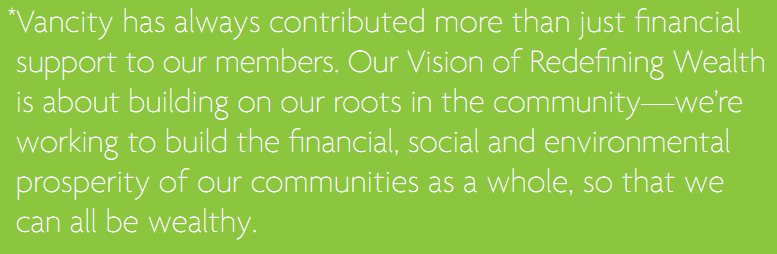
The practices and example of the Grameen Bank exemplify creative thinking and dedication to sustainable aspirations (in this case, the eradication of poverty). The achievements of the Grameen Bank leave most Western Banks looking homogenous and deficient in leadership. One notable exception (you may know of others) is Vancouver’s VanCity Bank. This statement from their Accountability report indicates their willingness to show leadership at all three levels.


Another evidence of their commitment to sustainability is their relative longevity – Citizens Bank, a subsidiary, was talking about sustainability before the turn of the century. Closer to home (New Zealand) the Australian banks here were at least more conservative and responsible, sheltering us from the worst of the financial crises.

In the banking industry, the impact of their in-house sustainability initiatives are miniscule, compared to the greater impact of their products and services and the banking industry’s huge influence on economies. The banks to support are, yes, those who run fleets of green cars, but more importantly are engaged in leadership discourse in their industries. The worst examples of banking were the junk-bond traders that were essentially corrupt and dishonest. Who are the banking leaders who will follow the example of Muhammad Yunus and position the industry to both serve and prosper?

Retail

As with banking, you can imagine retailers who focus on in-house sustainability, but are locked into the need to grow their business. They may be tempted to sell whatever they can to make a buck with little focus on the environment or wider society.

It appears that Walmart has become a very positive exemplar of deep sustainability. They have a long way to go – but are taking initiatives from in-house sustainability, through to industry leadership. Here are examples:

In-house sustainability – For Walmart, electricity is their number two operating expense. They are moving on two fronts.LED lights have been installed in freezer panels, providing a 70% reduction in energy consumption. LED lights will eventually be rolled out throughout stores and carparks. Walmart also have installations of solar panels underway. Over 30 stores are already installed with another 20 to 30 in the pipeline.

Another massive opportunity to improve in-house sustainability is with Walmart’s transport fleet. This video refers to a goal to increase transport efficiency by 100% from a 2005 baseline, by 2015. By the end of July 2011, they have achieved 65%.

Impact of products and services – Walmart aspire to improve the quality of food that their customers eat. Here is an extract from a recent article:

With more than 140 million customer visits each week, we have an opportunity to make a real difference in the nutritional quality of the food we sell, so we have a long-term goal to make food healthier and make healthier food more affordable.

First, we are reformulating thousands of our private brand packaged food items and working with branded products to do the same. By 2015, we will:

  • reduce sodium by 25%
  • reduce added sugars by 10%
  • remove all remaining industrially produced trans fats in our packaged food.

And here is a video about organic lettuce production at Walmart.

Leadership role in sustainability – Because of its size, Walmart can be particularly effective as a leader in the retail industry. When they get interested in initiatives such as LED lighting, solar panels and transport efficiency, they indirectly accelerate the mass adoption of better technology by consequence of their size in the market place. Recently Walmart has turned its focus on food-waste, reacting to the news that approximately one-third of food produced globally is wasted and are working with the USDA on projects to reduce waste. They also are working to access produce closer to the point of sale.

The examples here are a sample of the great work that Walmart is doing and provide a great illustration of a company engaging with sustainability across the three dimensions identified here.

Drive and imagination is the key

In the positive examples here, including Professor Muhammad Yunus of the Grameen Bank and Walmart, we see clear evidence of a desire to create a better world. This drive in turn generates the cognitive resources of imagination and breadth of vision that create new possibilities and transform industries from the top to the bottom.

I would love to hear of more examples.

Stakeholder engagement pays!

This blog positions stakeholder engagement at the leading edge of sustainability and also, as a core process underpinning a superior business model is transforming older, extractive and exploitative models. However, it is also great to have evidence that stakeholder engagement supports financial sustainability in addition to environmental and social sustainability.

Witold Henisz led a major Wharton School research project to deliver such evidence summarised in Spinning Gold: The Financial Returns to External Stakeholder Engagement. Here is the abstract from their document:

We provide direct empirical evidence in support of instrumental stakeholder theory‘s argument that increasing cooperation and reducing conflict with stakeholders enhances the financial valuation of a firm holding constant the objective valuation of the physical assets under its control. We undertake this analysis using panel data on 26 gold mines owned by 19 publicly traded firms over the period 1993-2008. We code over 50,000 stakeholder events from media reports to develop an index of the degree of stakeholder cooperation or conflict for these mines. By incorporating this index in a market capitalization analysis, we reduce the discount placed by financial markets on the net present value of the gold controlled by these firms from 72 to between 33 and 12 percent.

My (limited) understanding is that the reduction in net present value is increased significantly when stakeholder co-operation is low and stakeholder conflict is high. Here is a video explanation of net present value.

Apart from the great result, what impresses here is the size of the study and the stunningly positive result for stakeholder engagement. Notable too, is the assertion that mining companies that were once known for a myopic short-term view, are now “global leaders in the implementation of stakeholder engagement”.  A participant in the research commented:

It used to be the case that the value of a gold mine was based on three variables: the amount of gold in the ground, the cost of extraction, and the world price of gold. Today, I can show you two mines identical on these three variables that differ in their valuation by an order of magnitude. Why? Because one has local support and the other doesn‘t. (Yani Roditis, COO Gabriel Resources, interview by authors)

The researchers position the two factors of high stakeholder co-operation and low stakeholder conflict as essential to building the implicit or explicit social license to operate. Investing in positive stakeholder relations builds both social and political capital.

The nature of the research confines analysis of the benefits of stakeholder engagement to financial factors and shareholder value. As such it removes the tension between proponents of shareholder value, such as Milton Friedman and the broader stakeholder theory such as Edward Freeman.

Broader stakeholder benefits

In addition to the financial benefits of effective stakeholder engagement, there are other less tangible and quantifiable benefits. As more businesses learn to take a less extractive stance and engage more, the benefits of greater social capital compound. Trust is built and fractured communities develop more cohesion. If the ethos of external engagement of these mining companies becomes culturally embedded throughout the organisation, local people employed in mining operations, should also benefit from a more engaging workplace. Ideally these cultural practices become more manifest and normalised in worker’s families and the wider community. How is this quantified?

This landmark research in sustainability provides much-needed hard data to demonstrate the benefits of stakeholder engagement. One disappointment is the title – associating the PR metaphor of “spin” is unfortunate, as effective stakeholder engagement is the antithesis of spin. Ideally engagement is based on authentic and transparent communication rather than the more manipulative intention of spin. But hats off to Witold Henisz and his team for a superb research contribution.

Sustainability – what’s real?

There are a belwildering array of sustainability ratings – but what do we believe? How do we know they are measuring and evaluating the right things?

In their Rate the Raters documents, SustainAbility identified over 50 sustainability rating agencies. SustainAbility will offer insights into how credible each rating system is, but I suspect that many imponderables will remain.  For example, in part two of the study, the Dow Jones Sustainability Index was ranked highest in credibility by the study’s participants. But in his article titled,When Pigs Fly, RP Siegal noted with incredulity that Haliburton is now listed in the Dow Jones Sustainability Index.

Here are two reasons that determining a company’s sustainability will remain problematic:

  • the bureaucratisation and commercialisation of quality processes
  • determining sustainability

 The bureaucratisation and commercialisation of quality processes

In the galaxy of organisation endeavour, sustainability reporting can be regarded as a quality measure. For example, while the ISO 9000 series deals with operational quality matters, the ISO 14000 series deals with environmental management. While ISO 14,000 may not be classified as sustainability reporting, it serves the same purpose, in that it provides third party assurance of a quality measure.

I like Tom Peters perspective on quality. He quotes Richard Buetow, a Motorola executive.

With ISO 9000 you can still have terrible processes and products. You can certify a manufacturer that makes life jackets from concrete, as long as those jackets are made according to the documented procedures and the company provides next of kin with instructions on how to complain about defects. That’s absurd.

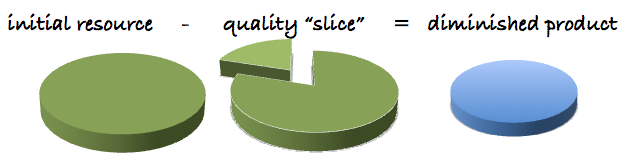
Where quality processes are formalised, they can divert resources from the product or service itself. Any product or service will justify a finite amount of resource input, so ideally, any quality process will add value equal to or greater than its cost. Too often, compliance-driven quality processes militate against quality as they divert resources away from product or service delivery. This is a big issue in service delivery sectors such as education and health. When teachers spend more time on quality assurance processes, they spend less time on preparation for delivery. It may be that, unless there is a compelling reason to get third party assurance, that resource is best invested in enacting sustainability aspirations, rather than measuring them.

I’m not arguing against quality processes – but I am stressing that they have to add value. Sustainability reporting processes will add value to the economic bottom line where there are game-changing benefits. For example:

  • a supplier demonstrating conformance with a client’s ESG (environmental, social, governance) standards to ensure continuance of business
  • securing a listing in a sustainability index
  • remediating reputation losses.

But unless there are clear benefits from quality process third party assurance, why bother?

BP’s gulf oil spill illustrates this issue. Along with Shell, BP scored consistently highly in GRI (Global Reporting Initative) reports, and I believe the company’s leaders had, and have, genuine sustainability aspirations. BP invested a lot in rebranding as “beyond petroleum.” But the gulf oil spill incident has undone a lot of the energy BP had invested in sustainability initiatives. What the GRI couldn’t assess, were complex embedded processes, such as the quality of engagement between BP and its suppliers, and the impact of budgets and deadlines on safety and operations. (This video recounts BP’s PR problems)

Commercialisation

No doubt ratings agencies are also well motivated, but budget pressures will typically create pressure to grow the business and perhaps make processes than they need be. SustainAbility’s Rating the Raters cites commercial pressures as an impediment to more transparent report, partly because the raters are paid by those being rated.

Determining sustainability

Part two of this blog will explore what sustainability means in different industries, and from whose perspective.

Engagement stories – the New Zealand Army

The New Zealand Army provides an inspiring example of a journey of engagement, and how the engagement ethos supports their effectiveness in the field.

New Zealand is a young nation with a compressed history. 150 years ago, British and Colonial forces were engaged in a series of wars with indigenous Mäori tribes, leaving the inevitable sense of disengagement and division between the combatants. In the following century, the young nation responded to the call of “mother England” and sent young men to fight and die in the killing fields of the world wars.

New Zealanders see our tragic cathartic involvement in the Gallipoli campaign as a crucible for forging our national identity and accelerating the process of cutting the umbilical chord to the mother country. In the Second World War, many young Mäori volunteered and fought with distinction as the Mäori Battalion.

Ngati Tumatauenga

A few years later, in 1949, the NZ Army badge was adapted from the British Army design. The British Army asked for the letters “NZ” to be added to provide differentiation from their badge. Fifty years later, in 1999 the New Zealand Army adopted a new badge incorporating the words Ngati Tumatauenga (God of War)  and replacing one crossed sword with a taiaha.

These outwardly subtle artifactual changes reveal a story of the integration of the army’s twin heritages of the British soldier and the Mäori warrior. The taiaha is a traditional Mäori weapon. Ngati Tumatauenga is a tribal name – the New Zealand Army reconceptualised with a tribal identity.

Ngati Tumatauenga acknowledges what the Army is one family of people bound together by the ethic of service to our country, military professionalism, common values, and mutual respect, mutual trust and camaraderie. As one people we are one tribe. Ngati Tumatauenga reflects our oneness and our unity; it has seen us develop our own New Zealand military cultural practices and ceremonial guided by Tikanga Maori on the one hand and British and European custom on the other. (from the New Zealand Army website)

We can assume that these badges represent a five-decade journey from an ethos of assimilation of Mäori culture in the army, to a more engaging ethos of integration with the consequent forging of a new identity.

It is significant that Mäori serve across the ranks of the Army, and New Zealand’s Governor General designate, Lieutenant General Jerry Mateparae, has been head of New Zealand’s Defence Force from 2006 after a distinguished career in the army.

Engagement

The New Zealand military is small by international standards, but over the last 100 years has punched well above its weight. The army has served in several war zones as peacekeepers. As Ngati Tumatauenga, it has achieved stunning success. Watch the YouTube video on this page or here for the inspiring story of the New Zealand led coalition bringing peace to Bougainville with “guitars, not guns”.

I believe the Army’s success in engaging local populations and rebuilding trust can be attributed to the evolution of the shared identity of Ngati Tumatauenga. Over time underlying assumptions of the supremacy of European modes of operation were eroded and the voice of a minority culture emerged. This process could only be achieved through effective internal engagement, creating a culture that is a platform for external engagement.

Note from the video, that the inclusion of women in peacekeeping was a major asset.

Mäori have achieved much in the army, but in wider New Zealand society, they are over-represented in statistics about poverty, ill-health, unemployment and crime. It appears that wider society could learn much from the army. I would like to hear about private or public sector businesses, in New Zealand and elsewhere that have achieve impressive results through effective internal engagement.

Acknowledgements: Thanks to Bob Whiu for his help with this article.

Sustainability, engagement and the end of empires, part 2

We are nearing the end of the age of empires (see part one of this post). As the old world is crumbling under its own dysfunction, the new shoots of a new civilisation are discernible. This is the context for the shift to sustainability.

Civilisation by engagement and community building

With the old world essentially a spent force, impotent to deal with the complex issues we now face, the required course correction is a radical reorganisation of human communities and patterns of civilisation. In addition to developing the new institutions to support a new world order, we face the far more profound challenge – that of disrupting ancient and ingrained assumptions and patterns of behaviour, and supplanting them with new ones. This is no simple task.

Current sustainability discourse calls for change, but it is frequently posited as incremental change (albeit challenging enough itself). The environmental and social challenges facing us are enormous. We will struggle to reverse, or slow down some of the alarming trends, such as climate change, species extinction and resource depletion. But In some ways, the task of supplanting old patterns of behaviour, anchored and expressed in age-old human behaviours, is even more challenging. But the good news is, when we can achieve this, new patterns of human interaction will make it much easier to build sustainable communities.

The changes we are facing require the displacing of these old patterns of human behaviour with often diametrically opposed new patterns. For example, most human communities have used slavery as an economic resource. The practice persists today in locations where the prevailing cultural norms of subcultures view humans as objects for exploitation. This practice is unsustainable where human dignity is a dominant value and poverty is banished.

At present, we are in a twilight zone, where many are working hard to implement sustainability interventions, but are doing so on the foundations of the old order. Many corporates struggle with schizophrenic personalities – the old “profit maximisation at any cost” personality, and the emergent “sustainability” personality. BP’s gulf oil spill personifies this. I have no doubt, the companies’ leaders are genuinely aspirational, but the hyper-competitive marketplace invokes “profit maximisation” behaviours. We are attempting to build a new world on shaky foundations.

Green shoots – community building

There are encouraging developments. Take community building for example. I am hopeful that we have reached the nadir of dislocated urban and suburban communities and we are beginning to connect more with our neighbours. In this Ted talk, Rachel Botsman talks about the growth of “collaborative consumption” – a phenomena driven partly by new peer-to-peer technologies.

And in my corner of the world, the city of Christchurch recently experienced two devastating earthquakes. Amidst the tragedies, it was heart-warming to see neighbours looking after neighbours. Two “armies” were mobilised – the student army, and the “farmy” army, the former, tertiary students, and the latter, Canterbury farmers. These armies cleared away the tonnes of liquefaction that covered streets and suburbs.

More green shoots – the global community

A hundred years ago most of our exposure was to homogenous others – those that were much like us. It was very easy to be embedded in and “us and them” world, when most other nationalities are strangers. Now we mix a lot more, we are broadening our empathy far beyond the homogenous cliques of the past. We are more likely to respond to the plight we see our fellow humans suffering. And science has taught us to that biologically, we are all much the same.

The attitudinal foundations

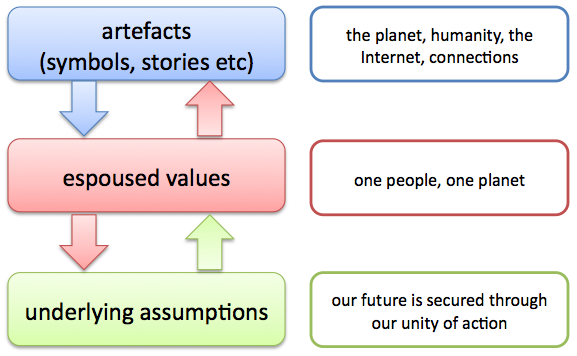
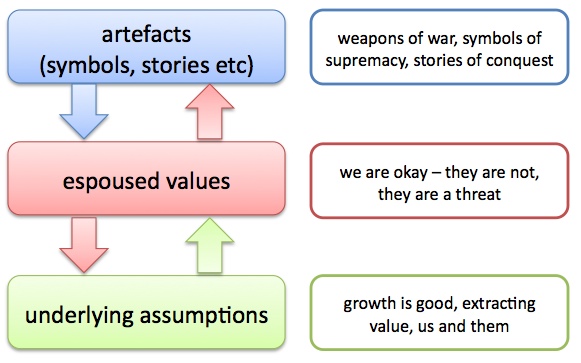
In the previous post, I outlined the underlying assumptions that supported the empire building ethos – “growth is good” – “extracting value” and “us and them”. Our new world requires an entirely different assumption: unity of action. Rachel Botsman advocated a shift from competition to collaboration.

We also have to overturn some deep-seated beliefs about human nature. For example, we can live peaceably together, and we can transcend self-interest.

Is it arrogant to think that we are living in the midst of epochal change? Could it be that we are indeed part of a transformation of human consciousness? I believe so, and in my next post, I will assemble some supporting evidence. What do you think?

Sustainability, engagement and the end of empires – the big picture

Here is a first in a series of blogs offering a interpretation of human history positioning the times we are in now as the end of a long historical saga of empire building, and the dawn of a new global civilisation. In later posts I will explore the parallel shift from economies of exploitation and extraction to sustainable economies. And the agency of civilisation becomes communication, rather than conquest.

Rift valley refugees

We are all descendants of Rift Valley refugees  – our ancestors left Africa thousands of years ago and dispersed across the planet. Thus began the long migration, with humans constantly expanding into new territory. My country, New Zealand, was the end of the line, first colonised only about a thousand years ago by my wife’s Mäori ancestors, and further colonised by my European ancestors in the last 200 years.

This grand human saga has been civilisation by conquest. One group of humans would establish a foothold in a locality, but never for too long before being displaced by another, usually violently. Alternately, a sub-group, motivated by aversion to the status quo and/or the lure of new horizons would move on to establish a new colony. For years, the planet had abundant resources to fuel humanity’s relentless expansion. There were brief periods of peace and stability, but few lives were untouched by conflict.

This became the default human experience and patterned behaviours such as displays of dominance, disputes over resources, and ingrained insecurity predominated. Edgar Schein’s model of culture can be applied to this pervasive human culture. At the top level of Schein’s model are artefacts – the artefacts of the age of conquest changed over time, along with the characters in the war stories, but the essence of the stories was the same. As our ancestors replayed the stories over time they ingrained underlying assumptions of what life is all about and reinforced enduring drivers of human behaviour – “growth is good”, “extracting value” and “us and them”. Occasionally, enlightened individuals and movements would emerge but they would typically be usurped by those possibly influenced by the new, but reverting to the old patterns of behaviour.

Schein’s model and the age of empires

Schein’s classic definition of culture indicates how these patterns of behaviour are reinforced as the right way.

A pattern of shared basic assumptions that the group learned as it solved its problems of external adaptation and internal integration, that has worked well enough to be considered valid and therefore, to be taught to new members as the correct way to perceive, think, and feel in relation to those problems. (Schein, 2010 page 18)

Course correction and the end of empires

This pattern of behaviour caused great injustices, but our species thrived. As we learned to further develop our intelligence we arrived at a point in our development, 250 years ago, to use machines to further accelerate our expansion and extraction of the world’s resources. But in the last few decades the combination of this new technology and the old patterns of thinking have manifested a set of problems dwarfing any that humanity has faced before. Its time for a course correction.

We also appear to be at the end of the age of empires. The social evolution of humanity has seen us aggregate into larger and larger groups and embracing wider loyalties. What we loosely call “Western civilisation” is the last of the empires, or perhaps more correctly, a cluster of empires. The centre of power has shifted from Europe to the United States and colonisation has been more by commerce than by occupation, but it can be seen as an extension of the processes begun by Europeans for over a millennia.

Economist Jeffrey Sachs, in his book Commonwealth, describes the process of convergence, whereby the United States position of a superpower is waning, and major economies head towards a state of convergence, where no single economy can dominate.

A new kind of global politics must take shape, built not on U.S. or Chinese preeminence, but on global cooperation across regions. Despite the reveries and fantasies of some, the age of empire is over, and certainly the age of a U.S. empire. We are now in the age of convergence.

Any thoughts so far. Part 2 of this series of posts looks at Civilisation by Engagement and Community Building. This blog is also published at Steps to Sustainability


Sustainability leadership report

How do you know if a company is green-washing, or over-promoting its sustainability performance? Brand Logic’s recently released Sustainability Leadership Report compares the perceptions of sustainability of 100 prominent brands, with their sustainability reality.

Their matrix, sorts the brands into 4 categories:

  • leaders – those who perform well in environmental, social and governance (ESG) dimensions of sustainability and successfully communicate their achievements
  • challengers  – who are performing well, but not getting enough credit
  • promoters – who are credited with ESG performance ahead of their actual performance
  • laggards – who are low in both dimensions
brandlogic’s Sustainability Leadership Report matrix
Notice that IBM hits the sweet spot of high sustainability performance and high sustainability perceptions.

The great news

This report surveyed three groups, purchasing/supply management professionals, investment professionals and graduating students.  They were asked :
When evaluating a company as a potential:
  • investment or investment recommendation
  • supply chain partner
  • employer
how important is it to you that the company act as a good corporate citizen, operating in a socially and environmentally responsible manner?
An impressive 88% felt that this was somewhat important or extremely important –  45% responding that it was extremely important.