Engagement explosion

If you consider the relatively recent development of stakeholder engagement, its fair to say that there has been an engagement explosion. Edward Freeman first articulated stakeholder theory in his 1984 book Strategic Management: A Stakeholder Approach. It took a decade or so to emerge from obscurity and the concept had to survive criticism from those that saw it as a threat to the status quo – the primacy of the shareholder.

Engagement’s advantage is that it is organic in nature. People engaging become networked and engaging with others, opening further possibilities for engagement. Thus grow is exponential.

Fair trade

The growth of the Fair Trade movement is impressive. Harriet Lamb’s book Fighting the Banana Wars and Other Fair Trade Stories reveals explosive growth in Fair Trade sales.

The Fair Trade movement is a great example of the growth of engagement networks. The great achievement of fair Trade is in connecting the polar ends of the supply chain, the producer and the consumer. Before Fair Trade came along, most of us gave little thought to the origin of the bananas, or coffee or chocolate we consumed. But through the advocates of Fair Trade promoters we have learned that growers of these crops are often exploited by distribution and marketing systems. We have learned, for example that young people in African countries work as slaves on cocoa farms. Some of us know that coffee grown in the canopy of tropical forests creates great coffee in conditions that supports the ecosystem and is supported by that system. We don’t personally know the growers, but we learn that the Fair Trade system enables some of the money we pay for our coffee to help provide education for their families.

The Fair Trade example is just one example of the conversion of supply chains to value chains. I haven’t accessed product information using quick response (QR) codes with a cell phone, but the technology is there to provide more information about products and the people involved in their production, collapsing the supply chain and connecting producers and consumers.

The Internet   

The red line in the above graph shows the explosive growth of the Internet. We are still too close to the advent of this remarkable technology to fully appreciate the impact it is having on human interaction. I recall when I was writing my first book in the late nineties, I came across the Grameen story. I found Muhammad Yunus’s email address and asked his permission to use his story. He responded next day and a few days later the relevant chapter was written. More recently, I was able to connect with John Elkington through Twitter and ask for an endorsement of the revised edition of my book. He graciously agreed. Living at the bottom of the world, in New Zealand, I have been able to make connections that would have either been much more laborious or impossible in earlier times. Like many of you I engage with people in online communities across the globe. My potential to connect has exploded. Distance has been nullified and social levels flattened.

These are just two examples of greater engagement and connection and notice that they have happened in less than two decades. Profound changes are happening that will radically transform business and society for the better. I would be interested to know how greater engagement is happening in your life.
Staff engagement – more evidence

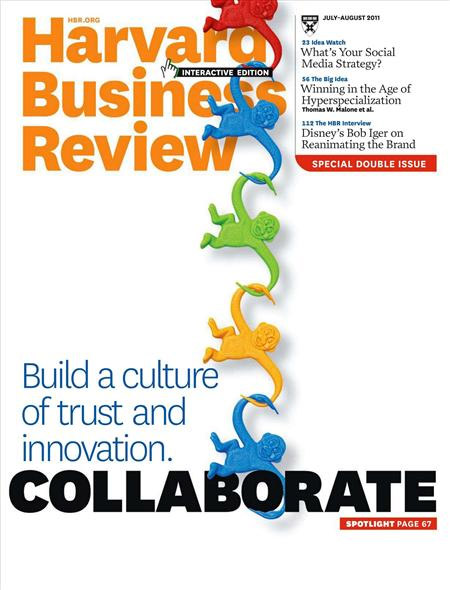
The evidence for the vital role of staff engagement continues to mount. The July/August 2011 Harvard Business Review includes a series of articles on collaboration. Yochai Benkler’s article The Unselfish Gene explores the fundamentals of human nature, challenging concepts of rational self-interest promulgated for so long. Scientists, psychologists and economists are now stating that people are less selfish than previously assumed. There is also “neural and, possibly genetic evidence of a human predisposition to co-operate”.

These findings support Jeremy Rifkin’s vision of an empathic civilisation, based on our inherent capacity to empathise. Jeremy Rifkin asserts:

We have to rethink the human narrative…If we are truly Homo empathicus, then we need to bring out that core nature, …if it is repressed by our parenting, our educational system our business practice and government, the secondary drives come, the narcissism, the materialism, the violence, the aggression.

Benkler’s HBR article presents the command and control systems that still dominate the business landscape as an emanation of the assumption of dominant self-interest. As our inherent collaborative nature is fostered, organisations will benefit from building cooperative systems encouraging communication and, “fostering empathy and solidarity”.

Other articles in the issue emphasise:

  • the need for collaborative leadership
  • create space for collaboration
  • building community
  • creating a culture of trust and teamwork.

Déjà vu?

While the biological basis of our empathy and cooperative nature have only been determined over the last decade, much of what is written will be familiar to those who have studied business. It’s over 50 years ago now that Douglas McGregor articulated theory x and theory y in his book The Human Side of Enterprise. There is a tidy correlation between the theory x position that people are inherently lazy and need to be coerced to work, and the assumption of people driven by self-interested. And the theory y position – that people can enjoy work and are intrinsically motivated aligns with the assumption that people are wired for cooperation and empathy, and want to belong.

So why, after 50 years does command and control remain the default management practice? I suspect it is because these practices have dominated human relations for millenia – such patterns of behaviour will not atrophy easily.  Jeremy Rifkin’s insightful observation that the secondary drives will dominate, reinforces the need to rehabilitate our social institutions and allow our inherent cooperative, empathetic nature to emerge.

Among the business writers to champion our higher nature is Stephen Covey. In this video, he traces human history and the legacy of command and control.

Engagement emerges as an essential pre-requisite to build the relationships that embed cultures of trust and teamwork. Engagement practices are generic, enabling them to be used for the full range of stakeholders, internal and external, that businesses need to co-create their futures with. Yochai Benkler, in his HBR article provides at once pragmatic and aspirational “levers” to achieve this:

“encouraging communication, ensuring authentic framing, fostering empathy and solidarity, guaranteeing fairness and morality, using rewards and punishments that appeal to intrinsic motivations, relying on reputation and reciprocity, and ensuring flexibility”

What do you think?

Stakeholder engagement drivers – Part 5: altruism

In earlier blogs in this series we looked at self-interest and enlightened self-interest as sustainability and stakeholder engagement drivers. This post explores altruism as a driver.

It seems natural that business leaders who prosper seek ways to give back to the community. The survival imperative driving the earlier days of their careers may have prompted self-interested behaviours. As survival needs are met we move up the needs hierarchy. Maslow talked about self-actualisation – is altruism a manifestation of self-actualisation? Anthony Robbins includes contribution as one of six human needs.

We all have a deep need to go beyond ourselves and to live a life that serves the greater good.  It is in the moments that we do this that we experience true joy and fulfillment.  (Anthony Robbins from Personal Power II)

Altruistic enterprises come in various guises. They include:

  • philanthropic ventures initiated by the wealthy
  • not-for-profit organisations
  • profit generating organisations with an altruistic mission
  • social business.

Philanthropic ventures

Successful business leaders such as Bill Gates, Richard Branson and Warren Buffet have given millions. Bill Gates has set up the Bill and Melinda Gates Foundation, “dedicated to bringing innovations in health, development, and learning to the global community”. As these ventures typically target the disadvantaged, dealing with social issues, they are sustainable in intention.

Not-for-profit organisations

These are the most numerous of the “altruistic” sector. Many are strongly aligned with environmental or social sustainability issues. Most have strong survival instincts and devote significant effort to self-interest.

Profit generating organisations with an altruistic mission

Along with social businesses, these organisations have emerged relatively recently and have a clear sustainability agenda. The Grameen family of businesses established by Nobel Prize winner Muhammad Yunus is a clear example. Founded in 1983 the Grameen Bank now has over 8 million members. The mission of the bank is “to eradicate poverty”. The bank spawned several other innovative enterprises that raise the quality of life and well-being for the people of Bangladesh.  Muhummad Yunus’s letter to members, on the eve of his forced departure from the bank, beautifully summarises the Grameen story. This video about Grameen Shakti illustrates the multiple benefits generated by a brilliant altruistic business.

Social Businesses

Grameen Danone was launched in 2006. This social business was inspired by Muhummad Yunus and is a partnership between Gameen and the French company Danone. It stands alongside Danone’s for-profit businesses as a “no loss, no dividend” company. Any profits are returned to grow the business. Social businesses exist to deliver social good. Grameen Danone produces nutrient fortified yoghurt at a very low price to relieve malnutrition in Bangladesh. Muhummad Yunus also drove an environmental agenda, asking Danone to produce a biodegradable, and then edible yoghurt container! Several other social businesses have followed. Here is Muhammad Yunus explaining the social business concept.

The recent development of organisations such as the Grameen Bank and Grameen Danone are, I believe, indicative of a shift in human consciousness to a more empathetic business model that looks beyond self-interest and recognises our interdependence. These are the early days – it is exciting to imagine what will emerge as more businesses learn to transcend the drivers of self-interest. Tell us about where you have seen these businesses emerging.

Stakeholder engagement drivers – Part 4: enlightened self-interest

In the last post in this series we looked at enlightened self-interest, illustrating the concepts with examples of Walmart’s sustainability initiatives. This blog explores McDonald’s journey towards sustainability.

McDonalds is one of the many companies that have embarked on a journey towards sustainability following negative publicity. In 1990 a group of protestors in London distributed What’s wrong with McDonalds? pamphlets leading to the “McLibel” case that was finally resolved in 2005. Over the last two decades McDonalds has been criticised for contributing to obesity, destruction of the rain forest, animal cruelty and human rights abuses.

Towards sustainability

McDonalds philanthropic initiatives started well before the McLibel days, with the establishment of Ronald McDonald House charities in the 1970s. In the last decade, the company has moved from philanthropy to broader sustainability aspirations. Two initiatives of note are the Weight Watcher’s partnership and Rainforest Alliance coffee.

McDonalds now offer meals that have WeightWatcher’s point ratings, providing customers with choices other than their traditional fare. They have taken other initiatives to improve the health of their offerings – sugar levels in buns have been reduced and healthier oils are used for deep-frying.

Promoting and selling Rain Forest Alliance coffee is a sustainability initiative that has multiple benefits. Growers are guaranteed better prices for product. Their families benefit through the provisions of social initiatives such as schools, and growing systems are more sustainable and environmentally friendly. As companies like McDonalds make products such as certified coffee available, they enable consumers to help contribute directly to the well-being of those that grow the product, thus creating virtue and connection throughout the value chain.

 Local engagement

The McDonalds store near where I live has been frequently upgraded and provides an attractive, clean and comfortable environment for customers. Free wi-fi is available. With its sustainability initiatives and in-store experience, McDonalds positions itself for improved customer engagement.

Any large company is easy prey for criticism and if you want to find fault, you will find it. But I believe that it is important to acknowledge their good efforts and encourage more.

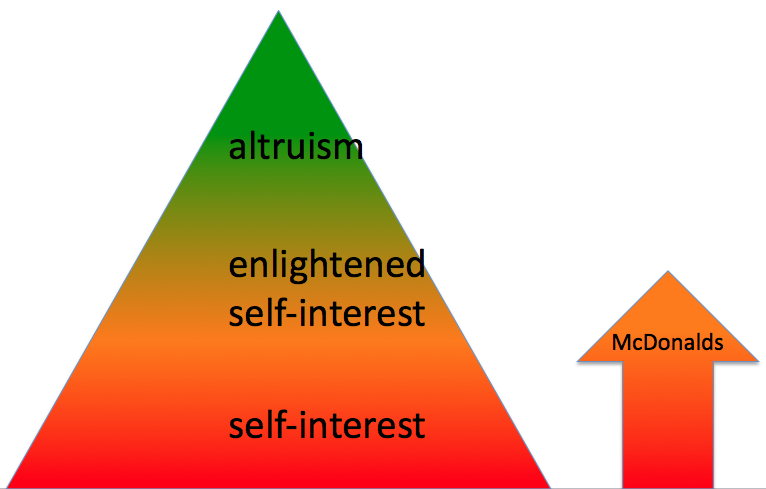
When I look at McDonalds through the three drivers lens, there is sufficient evidence that they are operating in the enlightened self-interest zone. Another way to check perceptions is to compare them to other fast food chains. Where I live, I don’t see much evidence any of McDonalds competitors moving into this zone. What do you see?

This three level model is a useful tool for a broad assessment of a company’s engagement and sustainability drivers.

Stakeholder engagement drivers – Part 3: enlightened self-interest

The first part of this series of blogs outlined three three drivers for stakeholder engagement, self-interest, enlightened self-interest and altruism. In this blog we will look at enlightened self-interest using Walmart for illustration. Such companies want to make money and be more sustainable. They attempt to operate in ways that are not just financially sustainable, but also factor in the well-being of others and care of the environment. They look for synergy in these aspirations.

The sweet spot

The emergence of sustainability as a major driver of business decision making is now undeniable. Companies that attempt to privilege their own self-interest over broader societal and environmental concerns will become increasingly irrelevant. Smart companies pursue the “sweet spot”, of synergy between self-interest and creating value for society and the environment. In the sweet spot self-interest becomes meritorious.

 Walmart as an example of enlightened self-interest

First some disclosure: I live in New Zealand – we have no Walmart stores so I rely in the media for my knowledge of Walmart. Much has been written about former CEO Lee Scott’s crucible experience in Hurricane Katrina and the company’s work to rectify negative publicity. Given its sheer size, Walmart still attracts negative publicity, but there is an increasing amount of evidence that they are a great example of enlightened self-interest.

In part one of this series, factors that indicate enlightened self-interest are:

  • engagement focus
  • creating value chains
  • sustainability aspirations
  • values driven decision-making

And as they embed these practices evidence of altruism starts to emerge and the organisation becomes more driven by the greater-good. Here are some examples. They explicitly illustrate the creation of value chains and sustainability aspirations, and we can infer they require an engagement focus and values decision decision-making.

Creating shared value with suppliers

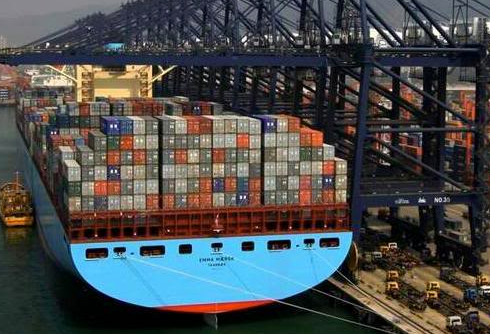
In each trans-pacific journey from China to Walmart, the massive Emma Mersk transports 15,000 containers. With 60,000 suppliers, it must be difficult for Walmart to achieve intimate engagement with each, but the company can have a huge influence in ramping up sustainability expectations. With larger suppliers, such as Peterbilt, Walmart are working closely in pursuit of its sustainability aspirations. Peterbilt recently delivered eight hybrid trucks to help Walmart achieve its goal of 100% increased efficiency by 2015 from a 2005 baseline. In this video Hunter Lovins, of Natural Capitalism Solutions, states “Walmart may now be the centre of environmental responsibility on the planet”. By combining improved aerodynamics, auxiliary power units capturing energy from breaking, improved rolling resistance in tyres and improved load management Walmart has already achieved 60% reductions. Walmart’s aspirations reduce costs and pollution, delivering on self-interest and benefits for customers, suppliers and the environment.

Learning from criticism

If Walmart was motivated solely by self-interest, it would choose suppliers based mainly on cost. In a recently announced initiative, the company revealed plans to double what it buys from businesses owned by women by 2016. The initiative will support women’s economic development both in the U.S. and other supplier nations and promote greater gender and minority presence through the entire value chain. Earlier this year, a class-action lawsuit by some of Walmart’s female workers was dismissed by the US supreme court. Whether or not these issues are linked indicates that Walmart continues to respond to and learn from public perception.

Public health – towards altruism

Walmart’s recent initiative to require suppliers to reduce sugar and sodium in foods, and to eliminate transfats is another great example of enlightened self-interest – the company has been criticised for being part of the American obesity culture. This initiative has potential to generate huge good, as Walmart supplies 25% of the nations food. Those suppliers and others will now be rethinking their role in public health. As Walmart ventures more into this territory, is it on the cusp of altruism? I welcome your thoughts.

image credit: http://www.politicalravings.com/everything-else/677-wal-mart-ship-from-china.html

Building capacity for employee engagement

The great thing about building engagement capability is the broad range of benefits. Engagement reshapes the nature of the relationship the organisation has with its stakeholders, be they customers, suppliers, owners, employees or the community. Reshaping the relationship with employees appears to have significant potential.

It doesn’t take long to find a damming array of reports revealing that, in most cases, employee engagement is woeful. Without labouring the point, here are some examples:

Employee engagement by region, from the
2011 BlessingWhite Employee Engagement Report 

The good news is that there appears plenty of scope to improve engagement. The even better news is, that the capabilities required to improve engagement with employees will be beneficial in other stakeholder relationships.

I may be biased, but engagement capability needs to be at the epicentre of organisational development.

Think of it this way; What action would you take if only a third of your vehicle fleet operated reliably, or your core systems rarely achieved their potential? I am sure you would focus your attention on it. So why is it that many organisations are unable to more fully engage their employees?

Engagement capabilities

Some organisations survey employees to learn more about engagement, but these surveys can actually further erode engagement if employees perceive that there is no follow up. Further analysis is probably not useful. Fortunately, the essence of engagement is in one-to-one relationships between people, and therefore capability for engagement can only be enhanced when individuals work on their engagement skills and develop those aspects of character that support engagement. These include integrity and trust. The Korn/Ferry Whitehead Mann UK Survey found a clear deficit of these qualities where there was poor engagement.

The engagement spiral

The popular TV series ‘Undercover Boss” week after week demonstrates what happens when company leaders take time to get to know their employees. Typically their employees respond strongly when their boss acknowledges the effort they invest in the company. And as they get to know something of the private lives of their employees, empathy increases.

Of course organisational leaders do not have the time to engage with all employees, but all employees should have the opportunity to engage with someone with a leadership role. A sense of belonging and connection with the wider social group, including its leaders, is a fundamental human drive.

Developing engagement capability

The skills of engagement are simply communication skills, including listening, acknowledging and empathy. These are supported by qualities of character such as integrity and trust. Formally, these skills can be fostered in organisational development programmes in communication, leadership, change and organisational learning. And given the critical role that engagement has in 21st century organisations, they must be regarded as core skills for performance management purposes.

In earlier series of posts I identified engagement as one segment of the communication spectrum. Understanding the distinctive nature of engagement helps us to be more discerning about how we communicate, and helps us aspire to higher expressions of communication.

The tools needed to improve engagement are simple and close at hand. There are no quick fixes – the journey to improving engagement requires constant vigilance, but the returns promise to be significant.  Understanding the communication spectrum is a good place to start.

More engagement lessons from the Canterbury earthquakes

Recently, John Hamilton, the Director of Civil Defence Emergency Management, New Zealand, spoke about the Canterbury earthquakes at the National Board meeting of Neighbourhood Support.

Resilience and personal fortitude

John was effusive in his praise for the “personal fortitude” of Cantabrians and the resilience of their communities. Their response has negated the myth of weak neighbourhood spirit prevalent in pre-quake discourse. The tragic impacts of the earthquakes have strengthened community engagement and communication.

the Student Volunteer Army in action in Christchurch

In immediate response to the quakes, Christchurch citizens checked on their neighbours. In the following days and weeks, community groups such as the student army arose and self-organised to check on people’s well-being and remove the liquefaction flooding streets and properties (see an earlier post). Unlike many overseas disaster scenes, Christchurch people used emergency accommodation for just a few days and quickly returned to damaged homes (where that was safe). Most of the fatalities occurred in the CBD, but thankfully residential buildings performed well and no lives were lost in residential building collapses. And, according to John “schools did a fantastic job” – no school children lost their lives.

Situational awareness

But the people of Christchurch and Canterbury weren’t anticipating an earthquake, and may not have been as well prepared as they could have been. The authorities found it difficult to get timely and accurate intelligence about immediate impacts and particularly in suburban areas. Effective community networks established before any disaster help the authorities gain situational awareness and better target response actions.

John believes that Wellington, New Zealand’s capital city, has heeded lessons from Christchurch and is improving community preparedness. Wellington sits on a major fault line and people have been anticipating “the big one” for decades. Wellington civic leaders have engaged at community level to build emergency response capacity. Should a big earthquake occur, Wellington’s strong community infrastructure should  enable a good response.

Neighbourhood Support’s role

Community groups such as neighbourhood support play an important role in fostering community engagement. Neighbourhood Support was originally set up to improve security and reduce crime in neighbourhoods. This necessary, but reactive role, is dramatically enhanced by the more pro-active community engagement role – where people are encouraged to get to know their neighbours. Thus resilience is built into communities as people learn (or relearn) to engage with neighbours. Resilient communities are better placed to respond to destructive events, whether they be natural or man-made. And on the positive site, increased neighbourhood engagement opens up opportunities for an enriched social life and greater prosperity through community initiatives.

If you want more information about neighbourhood support, or would like to form a neighbourhood support group check out the Neighbourhood Support New Zealand website. Please comment – I would be interested to know about similar initiatives in other countries.

image credit: http://iprepared.blogspot.com/2011/02/helping-each-other.html

Stakeholder engagement drivers – Part 2: Self-interested organisations

In the first part of this series of posts we looked at three levels of commitment to stakeholder engagement, self-interest, enlightened self-interest and altruism. This, and the following posts will expand on these and illustrate them with examples.

The antithesis of engagement

Lets start by looking at an extreme level of disengagement – methamphetamine (P) production and distribution. This example shows how the core business impacts negatively on a range of stakeholders.

The classic approach to stakeholder engagement is to look at categories of stakeholder engagement – owners, employees, suppliers, customers and the community. If we consider P production from a suppliers perspective, raw ingredients are sourced either in bulk from unscrupulous suppliers, or from chemists (drug stores). Chemist shops (in New Zealand) have collaborated with Police to restrict this source. As a consequence, medicines, once readily available for genuine consumers are now difficult to access. Chemist shop staff have additional layers of security checking to cope with when selling the product.

People that rent houses that are used to “cook” P are another unwitting supplier and therefore stakeholder. These houses are left drenched in toxic chemicals and require detox processes to prepare them for the next tenant.

A high proportion of users get addicted to P and their behaviour and priorities change. This might include resorting to gambling, stealing from employers, family and others. The families of P addicts often despair at the changes that the drug induces in the addict. The increase in crime, generated by the need to secure funds for the continued supply of the drug, diverts police resources as does the activity required to counter the drug production and distribution. Other crime fighting initiatives may well be under-resourced exposing citizens to more crime.

Without expanding further, we can see that in this case, the “commercial activity” has negatives that cascade through the community. The stakeholders of the illegal drug industry are many and varied and the impacts can reach deep into our communities.

Other examples

Sadly, examples of organisations disregarding the well-being of stakeholders in their pursuit of profit are all too common. Here are some examples:

  • The tourist operators along the Gulf Coast became stakeholders of BP and Halliburton when oil washed on to their beaches.
  • Those of us that carelessly discard plastic waste may well cause marine life to be consumers of the waste, and therefore stakeholders. Albatrosses in the Pacific consume plastic, thinking it to be food. Their gut can fill with plastic, leading to certain death.
  • Alcohol companies and their marketing agents that target young people with promotions help to foster a binge-drinking culture with sometimes devastating social outcomes.

An unwitting stakeholder – a young albatross killed by plastic waste  

While the illegal drug industry is an extreme example, it illustrates that organisations that operate from self-interest, can generate significant unintended misfortune for stakeholders. We can expect that organisations that operate from higher motives can generate significant good, as we shall see in subsequent posts.

image credit: Science News for Kids

Stakeholder engagement – what are the drivers

If you want your organisation to engage better with stakeholders take some time to understand why. This blog explores three levels of commitment to stakeholder engagement – self-interest, enlightened self-interest and altruism. As with any classification system, these levels are arbitrary and could be endlessly debated – they are simply offered to stimulate thinking about your motives and drivers.

Implementing an initiative, such as stakeholder engagement is more likely to be successful if there is congruence between your thoughts and your actions. According to Sue Knight, our behaviours (what we say and do) are driven by the sub-surface factors of purpose, identity, beliefs, values and capabilities (see The heart of sustainability for more detail). So, for example, if you are just desperate to make money, and for your business to survive, your behaviours will reflect this.

Self-interest, enlightened self-interest and altruism

Self-interest: These are businesses that want to make money and survive – and that includes most business. But those who pursue this solely, will use any means within their ethical and legal boundaries (most of the time). Broader considerations are sublimated to the profit motive.

Enlightened self-interest: Businesses that want to make money and be more sustainable attempt to operate in ways that are not just financially sustainable, but also factor in the well-being of others and care of the environment. They look for synergy in these aspirations.

Altruism: These organisations are either established with altruistic missions or develop those as their owners turn from business-success to deeper motivations.

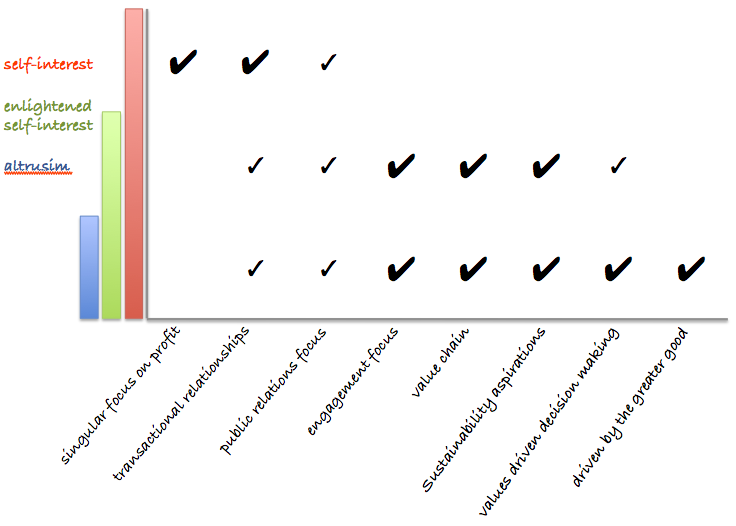
In this diagram, these levels are presented in a matrix. Notice that the self-interested motive persists in the other two levels – all organisations want to survive. And enlightened self-interest is compatible with altruism – successful businesses have more resources to give. Following blogs will look at examples of each of these levels of business and the behaviours they engender.

What drives your organisation?

Here is a series of statements based on the factors in the diagram above. They can be used as discussion starters, or for a quick evaluation of your organisation. If you want to add numbers:

  • 0 = my organisation is not like this
  • 1 = my organisation is a little like this
  • 2 = my organisation is like this
  • 3 = my organisation is a lot like this

Singular focus on profit: Our primary motivation is to contribute to a better world.

Transactional relationships: The success of our organisation depends on our ability to create great relationships with our stakeholders.

Public relations focus: Good public relations are important to us, but more important is open and transparent engagement.

Engagement focus: We see engagement as a core organisational competency that underpins our success.

Value chain:  We work with staff and suppliers to add value for both parties, valuing long-term relationships.

Sustainability aspirations: We are driven to maximise the triple-bottom line, for prosperity, people and the planet.

Values driven decision-making: Our values guide our decision-making – if an opportunity doesn’t sit well with our higher values, we won’t pursue it.

Driven by the greater-good: Our primary motivator is to contribute to the well-being of humanity.

Results:

  • 0 to 8: At the low range, your organisation has a singular focus on profit, if you are at the higher, perhaps your organisation is on the cusp of enlightened self-interest.
  • 8 to 16: Your organisation shows signs of enlightened self-interest and could well be on a trajectory towards sustainability.
  • 16 to 24: Your organisation is manifesting altruism.

There are clear examples of organisations in each of these three categories. We will look at them more closely in following blog posts. And I would love to hear of your organisation’s journey towards altruism.

Engagement stories – back yard angels

Di Celliers was concerned about the increasing demand on food banks to feed the poor. She was also aware that a lot of fruit goes to waste in back yards. She drew on her social and church networks and workmates at the ASB bank to inspire and mobilise people to pick fruit in backyards.

In a little over a month, Di’s initiative has spread across Auckland and the idea has been picked up in other regions in New Zealand. Auckland City Mission now collect the fruit weekly and distributes the fruit to 70 foodbanks.

Community Fruit Harvesting now has a Facebook presence and a website is hopefully on its way.  The Facebook page is a great example of community engagement and social networking’s capability to connect people in a cause. You can hear Di talking about the initiative on National Radio. Here’s Di picking citrus.

Another Auckland initiative is ooooby.org, (Out of our own back yards). It has been set up as a social business that harvests produce grown in backyards, micro growers and from local farms. Customers sign up for a $27.90 weekly box of fruit and veges.

These initiatives are inspiring steps to a more sustainable means of food production and supply. The benefits include providing free or inexpensive, nutritious food, building community bonds through engagement and volunteering and providing micro-enterprise opportunities.

Here is Muhammad Yunus explaining the social business concept.

Images used by permission of Di Celliers